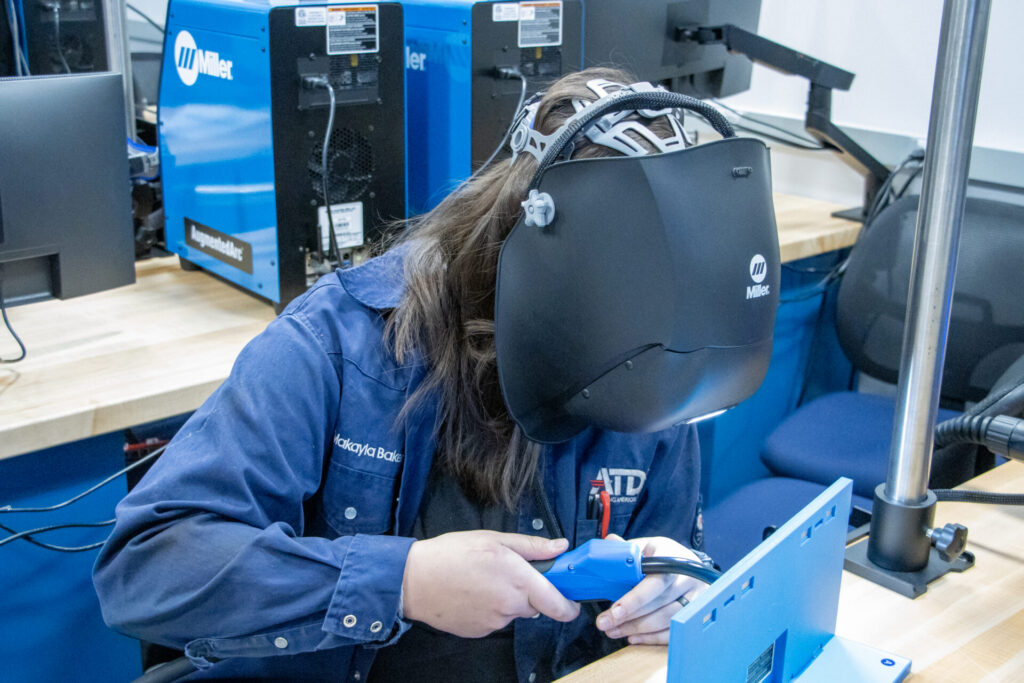
The hood drops. A gloved hand steadies the torch and slowly moves it across the coupon.
But the t-joint plate is made of plastic instead of metal, and no sparks are flying here.
In this new lab, the motions are the same, yet the heat, smoke and spatter are replaced by an augmented display that coaches each pass in real time. It’s a safer, smarter on‑ramp to the craft that will shape students into mission‑ready welders for the maritime industrial base.
Beginning with the current welding cohort, the Accelerated Training in Defense Manufacturing (ATDM) program is integrating augmented reality (AR) welding into its welding track to help learners build fundamentals faster, reduce consumable use and increase safety from day one.
“This augmented reality welding environment will help ensure that when students strike a real arc for the first time, they’ve already built some muscle memory and confidence.”
– Jason Wells, Executive Vice President of Manufacturing Advancement, IALR
With the installation of this new lab, students will now spend the first two days of each new welding process in the AR lab before transitioning to live arc welding — a structure intended to build muscle memory, reduce apprehension and make every minute in the booth more productive.
A Faster, Safer On‑Ramp
A program of the Institute for Advanced Learning and Research (IALR), ATDM prepares adult learners from across the country for high‑demand roles supporting the maritime industrial base through a focused, four‑month, 600‑hour training model. Now located at the ATDM Maritime Training Center — an advanced facility that trains 800–1,000 students annually — the program continues to modernize its tools and methods to reduce time-to-talent and increase training efficiency.
“We are always exploring how technology can impact and improve the educational journey for the student and, quite honestly, accelerate it even further,” Wells said. “We believe putting students in this environment will help them quickly grasp the basics of these new processes before moving to the real booth.”
Safety and confidence are major drivers of the change. For a student who has never welded before, stepping into a booth with a several‑hundred‑degree torch and molten metal can be intimidating.
“This technology allows students to get a little bit of comfort level and develop some muscle memory in a very safe environment,” Wells said.
Brian Greene, Welding and Engineering Manager for the ATDM program, described the move as both practical and forward‑looking.
“We are trying to reduce the time to talent potentially,” he said.
“As of right now, students spend two days in the augmented reality lab per process before they go into the live lab,” Greene said. “You get a realistic sound and feel for it without any of the heat and the sparks. As another benefit, they will have instant feedback on every weld.”
The Tech that Makes it Work
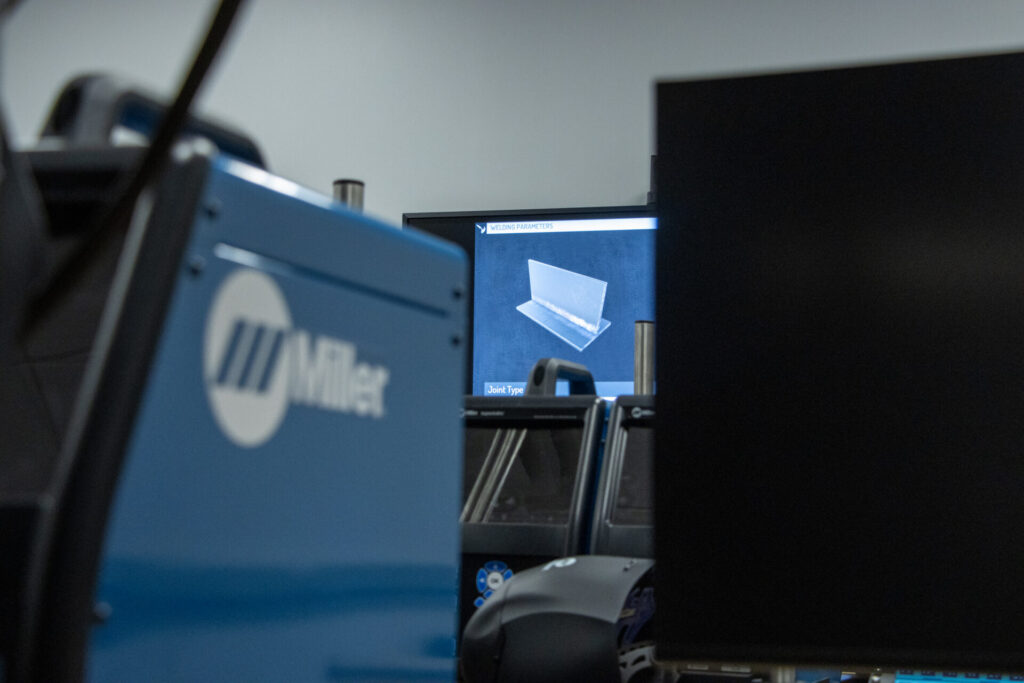
ATDM’s AR lab uses Miller Electric’s AugmentedArc platform, a system that blends real workpieces with computer‑generated overlays.
The machines can simulate the four primary welding styles that students learn in ATDM:
- Shielded and metal arc welding (stick)
- Gas metal arc welding pulsed (MIG)
- Flux-cored arc welding
- Gas tungsten arc welding (Tig)
When selected, the headset displays guides for angles, stickout and travel speed, providing instant feedback (green or red indicators) for each variable. The simulator records and scores each pass. Settings can also be configured to adjust scoring and difficulty for beginners, intermediates and advanced players.
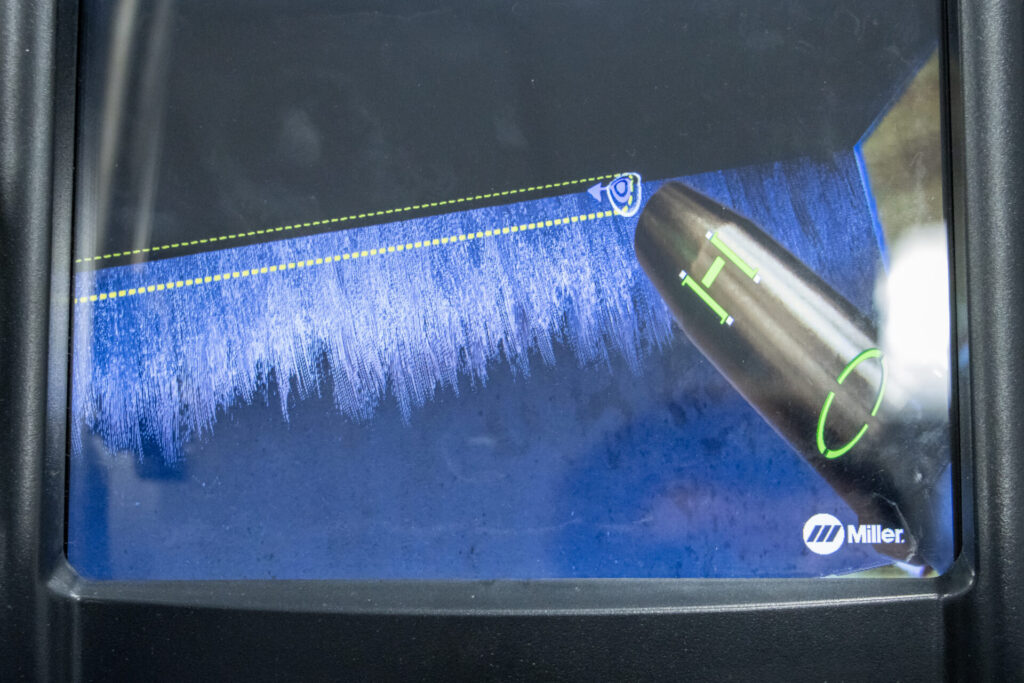
These analytics fundamentally change the early stages of learning.
“The simulators give honest, instant feedback on every weld and will allow students to adjust without any waste or worry about someone getting injured.”
– Brian Greene, Welding and Engineering Manager, ATDM
The system also significantly reduces early consumable waste. Beginning welders often burn through stick rods and wire before they develop rhythm and control.
“When they’re striking electrodes and making mistakes and wasting electrodes, there’s a lot of waste of consumables,” Greene said. “In an AR environment, there’s no waste of consumables.”
Instructor Makayla Baker sees the same value from the teaching perspective.
“This state‑of‑the‑art equipment will refine our approach in teaching new students the intricate details of welding. By utilizing this advanced technology, we can shorten the time from classroom to real, hands‑on learning.”
– Makayla Baker, Welding Instructor, ATDM
From a setup and operations standpoint, the lab includes a dozen stations connected to a front‑of‑room computer that will allow instructors to assign exercises and track performance without visiting each booth individually.
“The idea is that these simulators can shorten the training time for a welder,” said John Smith, training and technology manager, who helped with purchasing, room layout and installation. “This equipment will provide students with invaluable feedback, help us reduce costs and produce better welders.”
What Learners Experience First
Students begin with bead‑on‑plate and fillet‑style tasks that emphasize angle control, consistent speed and proper contact‑tip‑to‑work distance. The simulator provides visual prompts and alerts when the technique slips out of range, allowing students to correct mistakes immediately. After each pass, a replay and scorecard show exactly what went well and what didn’t.
By the time students strike a real arc in the booth, those fundamentals are already familiar.
Greene expects students to respond well to the format.
“With augmented reality, you are giving them those tools that they’re used to and taking some of the pressure off of doing it live,” he said.
That early comfort is expected to translate to stronger first attempts and a shorter ramp‑up to production‑quality work.
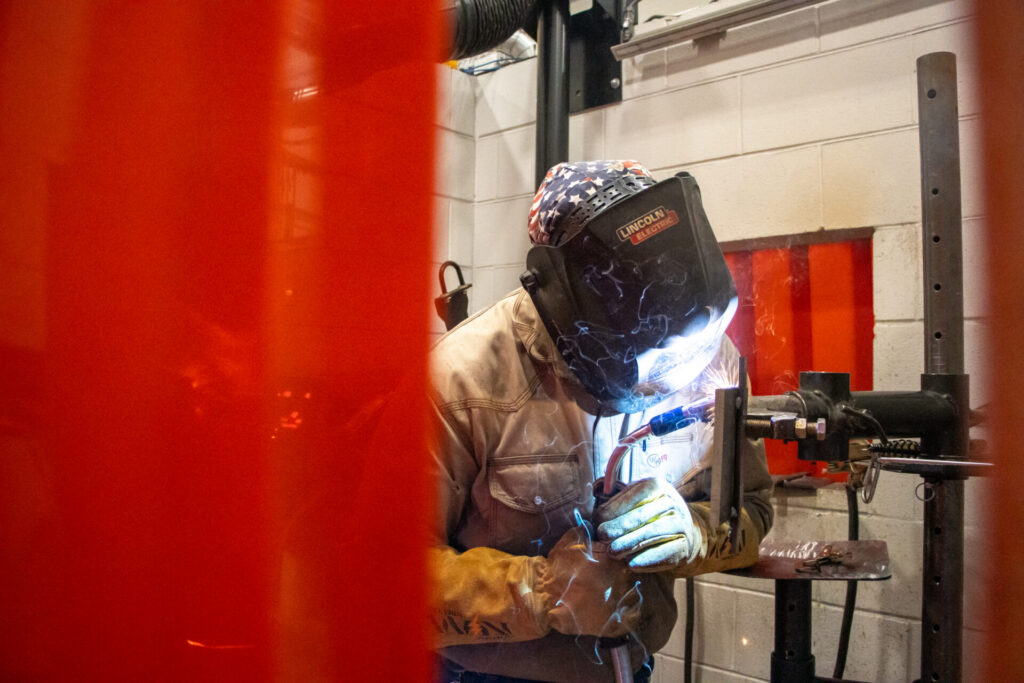
“This will accelerate our training speed to get them through the initial learning phase,” he said.
Time, Quality and Cost
The AR welding lab is designed to enhance the live welding training that follows. By front‑loading fundamentals, students enter the booth ready to focus on skill refinement rather than basic troubleshooting. That means less scrap steel, fewer wasted consumables and a more consistent student experience.
“If we can get some proficiency in an augmented reality environment, that helps from the cost of the program and a business perspective,” Wells said.
ATDM plans to closely track data from the first cohorts to quantify performance improvements and identify where AR training offers the most significant benefit.
In addition to savings on consumables and improvements in the student experience, ATDM leaders hope this will reduce required training time.
Partnership and Pipeline
ATDM acquired the AR welding systems through a partnership with Austal USA as part of a broader Industry 4.0 initiative with the U.S. Navy. ATDM’s role is to design curriculum, administer training and measure outcomes, strengthening today’s workforce pipeline while helping partners understand how emerging technologies can accelerate training at scale.
The same Miller AR units are used with Virginia middle schoolers in IALR’s Great Opportunities in Technology and Engineering Careers (GO TEC®) program, which is in 76 middle schools across the Commonwealth. GO TEC introduces 6th-8th graders to STEM and manufacturing skills and career pathways. A safe, approachable welding experience can spark early interest and widen the long‑term talent pipeline.
About ATDM
Housed at and led by the Institute for Advanced Learning and Research in Danville, Va., ATDM is a four-month, 600-hour training program offering five tracks — welding, CNC machining, non-destructive testing, additive manufacturing and quality control inspection (metrology), with tuition and furnished housing covered for accepted students.
This initiative is funded through the National Imperative for Industrial Skills by the Industrial Base Analysis and Sustainment Program Office within the Office of the Undersecretary of Defense for Acquisition and Sustainment.
The model emphasizes small cohorts, significant one-on-one machine time and wraparound support to move graduates quickly into well-paid roles across the maritime industrial base. With the Maritime Training Center now operating across three shifts, ATDM is positioned to train 800 students in 2026 and 1,000 students annually starting in 2027.