Manufacturers know that flexibility is key.
Traditional automation, however, often locks processes into rigid sequences and requires extensive hardcoding changes for adjustments.
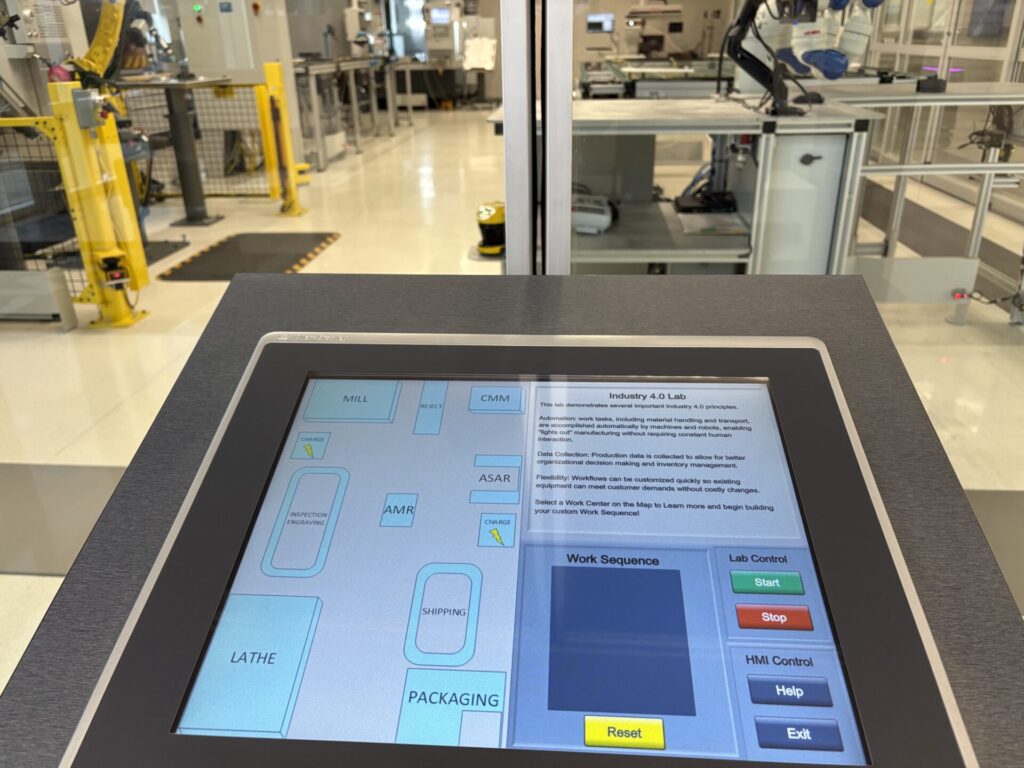
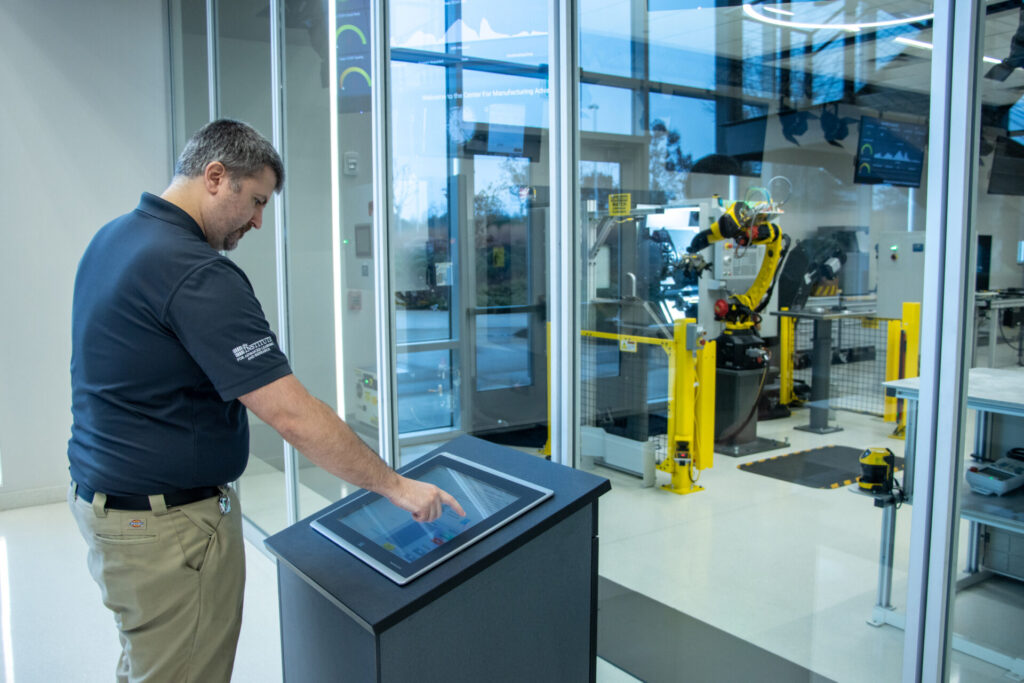
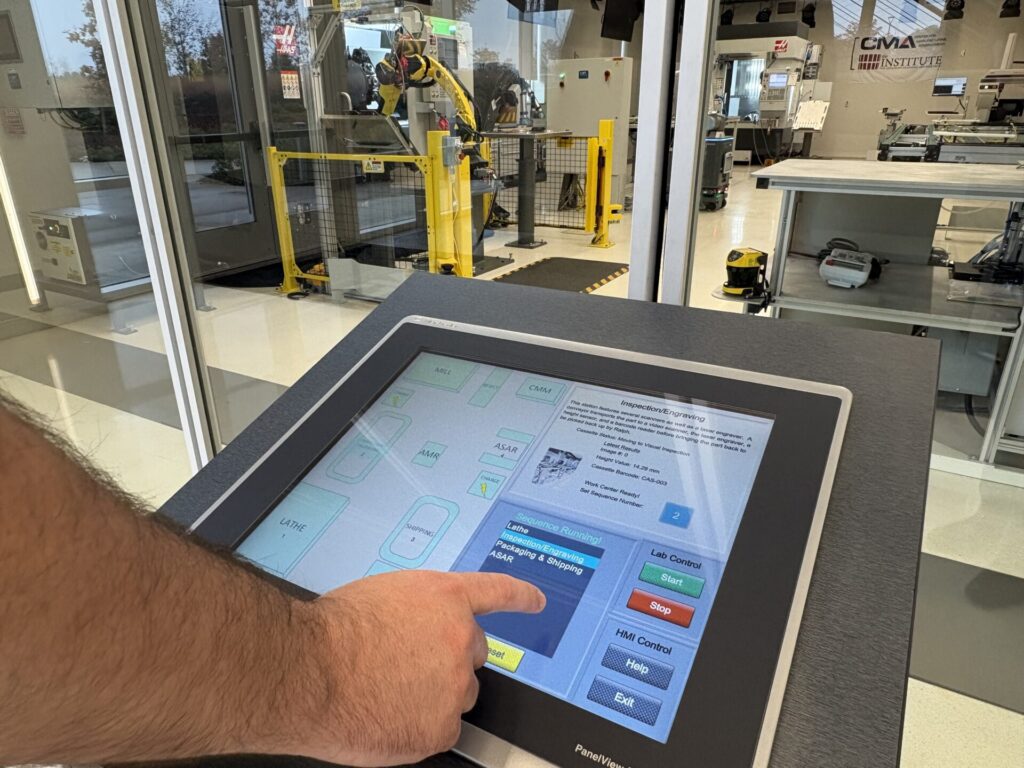
That’s changing inside the Industry 4.0 Integration Lab at the Center for Manufacturing Advancement (CMA) on the campus of the Institute for Advanced Learning and Research (IALR). A new interactive kiosk now allows visitors to design and customize their own manufacturing workflows, adding a hands-on element to a space built to showcase the future of connected production.
Instead of watching a fixed demonstration, visitors can now take control. The kiosk lets users choose which machines to use, select the order of operations and even create sequences that wouldn’t make sense in a real production environment.
This interactive feature illustrates the adaptability of Industry 4.0 systems, where workflows aren’t hardcoded but can be modified without extensive reprogramming.
“We are continually looking for ways to make CMA’s technology more accessible and to enhance the “what’s possible” experience for visitors of all knowledge levels in Industry 4.0.” – John Ring, Vice President of the CMA, IALR
From Fixed Recipes to Flexible Control
Previously, the lab operated on a pre-programmed workflow managed entirely by a manufacturing execution system (MES). The MES dictated every step: loading raw material into a CNC lathe, transferring parts for inspection, milling and final packaging. Each robot and machine communicated through the MES, following a rigid recipe.
The kiosk changes that dynamic. Visitors now function as the MES, selecting work centers and customizing the process. This demonstrates a critical Industry 4.0 principle: the ability to adapt quickly without rewriting code or reconfiguring hardware.
“The user is essentially functioning as the MES system,” said Adam Reeves, Automation and Robotics Specialist. “It’s rare to see this technology in action.”
Meet the Robots Behind the Workflow
The lab features three robots, each with a specialized role:
- Samson: Equipped with a compound gripper, this robot loads and unloads parts from a CNC machine.
- Ralph: This autonomous mobile robot (AMR) combines a mobile cart with a seven-joint robotic arm. Ralph moves parts between stations and tends the milling machine.
- Rosie: A dual-arm robot, Rosie is responsible for final inspection and packaging before placing finished products on a conveyor.
Together with two CNC machines and advanced inspection tools, these robots create a fully autonomous work cell capable of producing a finished part without human intervention.
A New Level of Connectivity
From the start, the Industry 4.0 Lab’s claim to fame has been interoperability: making different systems communicate seamlessly. Now, the kiosk demonstrates an even deeper level of integration. Programmable logic controllers (PLCs) can talk directly to Ralph using OPC UA (Open Platform Communications Unified Architecture), a protocol that has existed for decades but is picking up new momentum with industrial internet of things and Industry 4.0 principles.
“This just shows the capability of being able to extend the control,” said Butch Kendrick, Director of Digital Manufacturing at IALR. “Instead of each machine talking to the MES, this technology allows each machine to communicate directly with each other.”
By implementing OPC UA, the lab demonstrates a wireless, brand-agnostic communication channel that most companies have yet to explore. With approximately eight different brands represented, including four robot manufacturers, the lab proves that interoperability is possible, even in complex environments.
A Manufacturing Hub
The Center for Manufacturing Advancement provides state-of-the-art facilities, technology and expertise to position Southern Virginia as a destination for advanced manufacturers. From helping companies integrate automation to providing CNC machining consulting services, the CMA drives competitiveness and growth.
It also houses the U.S. Navy’s Additive Manufacturing Center of Excellence, which develops technical data packages for parts and components used nationwide.
By attracting industry partners and offering resources like the Industry 4.0 Lab, the CMA is helping manufacturers overcome challenges and embrace the future of production.