By: Melanie Lewis, Ph.D.
The 2025 Living Wage and Job Availability Study highlights something our healthcare partners know all too well: the demand for healthcare workers in Southern Virginia is outpacing supply.
From the study:
- Healthcare and social assistance make up 35.8 percent of all regional job openings, more than any other sector.
- As a region, we face a shortage of over 3,400 healthcare practitioners and technical workers.
This gap affects every community in the 15-locality GO Virginia Region 3, which covers much of Southern Virginia. It affects hospitals struggling to staff critical roles, first responder agencies responsible for emergency response, families seeking reliable care, and local employers trying to grow in an increasingly competitive environment.
This is not a future challenge. It is here now, and the region must approach it collectively.
Expanding Pathways in a Capacity-Constrained System
Many healthcare pathways in our region are capacity-constrained.
Clinical slots are limited, and instructor pipelines are thin. Many training programs would expand if they had the resources to support additional faculty, equipment or placements.
These barriers mean that even when students are interested, programs may not be able to enroll them, resulting in a bottleneck long before individuals reach the workforce.
At the same time, students often don’t know the breadth of healthcare roles, ranging from EMTs and CNAs to radiologic technologists, medical assistants, paramedics and RNs. When exposure is limited and pathways are unclear, interest struggles to take root.
And when programs cannot grow to meet demand, even students who want to pursue these careers may find the doors only partially open. These two issues of limited capacity and limited awareness reinforce each other, narrowing the pipeline before it even begins.
That’s why early interest must be paired with real, accessible opportunities.
Many healthcare programs across Southern Virginia want to grow, and the region needs them to grow, but doing so requires coordinated solutions that address barriers on multiple fronts. Building capacity at every level, from creating early awareness to expanding training infrastructure to supporting employers with new models like apprenticeships and work-based learning, ensures that students have both the desire and the ability to move into healthcare careers.
This holistic approach is essential for transforming interest into preparation and preparing for a stronger, more resilient healthcare workforce.
A Holistic Approach to Healthcare Career Interest and Training
At the Institute for Advanced Learning and Research (IALR), we believe solutions start long before graduation. Programs like the Career ChoICE Youth Expo expose thousands of middle- and high‑school students to healthcare careers each year. Many of our most compelling success stories come from partners like Sovah Health, where students first discovered healthcare roles at Career ChoICE and later pursued those careers.
But awareness alone is not enough. The region needs more structured, accessible on‑ramps into healthcare.
Through the ExTRA program (Expanding Talent through Registered Apprenticeship), IALR has helped employers build these on‑ramps by supporting the Danville Life Saving Crew with the creation of Virginia’s first EMT Registered Apprenticeship and Franklin County Public Safety with the state’s first Paramedic Registered Apprenticeship. These models allow employers to grow their own talent, offer paid training and retain skilled workers.
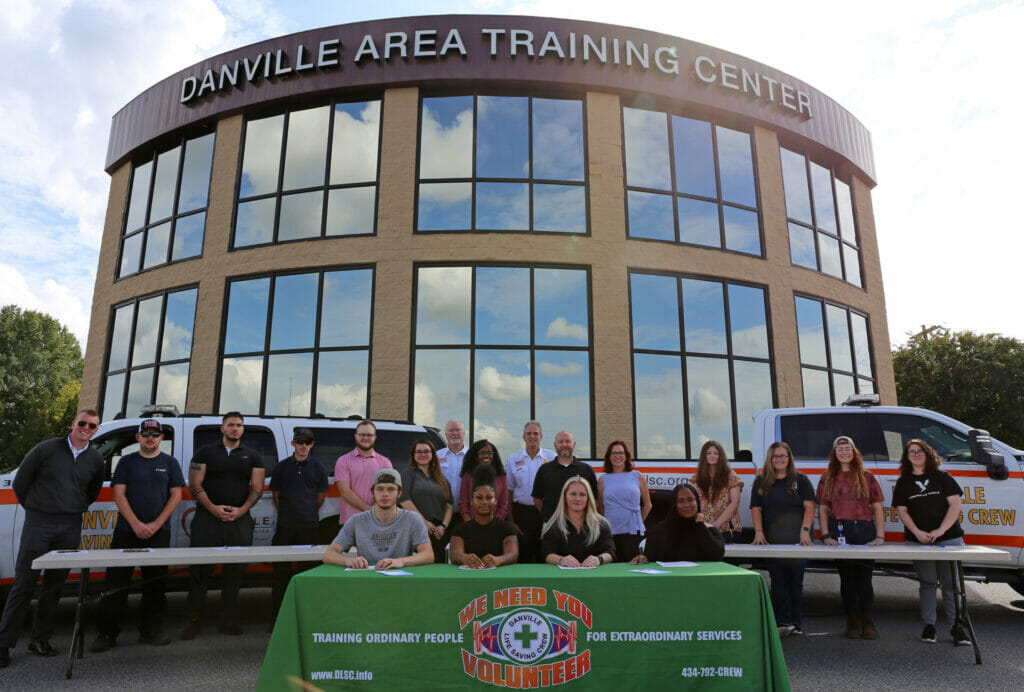
In partnership with IALR, the Danville Life Saving Crew – the primary Emergency Medical Services provider for the City of Danville – signed 13 individuals as Virginia’s first Emergency Medical Technician (EMT) registered apprentices during an October 2023 ceremony.
Another program administered by IALR, the Dan River Year AmeriCorps program, provides an early on-ramp into health careers. Members serve as community health educators, gaining hands-on experience working directly with residents on wellness, prevention and resource navigation. This structured service year is intentionally designed to give emerging professionals the skills and exposure needed to move into roles such as community health worker or other health services positions.
Our team also supports internships, job shadowing experiences for high school students and teachers, dual enrollment alignment and employer-driven work-based learning that helps young people build confidence and credentials. These efforts complement early-exposure programs like GO TEC, where Virginia middle schoolers explore healthcare modules, sparking their interest to pursue more rigorous training in high school and beyond.
While IALR does not grant traditional postsecondary degrees, we serve as a hub, connecting hospitals, EMS agencies, school divisions, community colleges, workforce boards and nonprofits. Our role is to convene, strengthen partnerships and help the region expand training capacity wherever possible.
IALR’s convening role extends to initiatives like the REACH Partnership, a systems-level effort to bring together healthcare providers, public agencies, nonprofits and community organizations to address community health holistically. Through coordinated care teams, shared public health education campaigns and a focus on reducing avoidable emergency department visits, the REACH Partnership improves the overall health ecosystem in which our future healthcare workers will serve.
Stronger community health outcomes support a stronger healthcare workforce and vice versa.
The healthcare worker shortage is too significant for any single organization to solve alone. But together, we can build a multi‑level pipeline that strengthens care delivery, supports families and contributes to a more resilient regional economy.
As the study makes clear, the future of Southern Virginia depends on our ability to prepare, attract and retain healthcare talent. We have strong partners, proven models, deep expertise in workforce development and a shared commitment to ensuring this region can meet the healthcare needs of every resident.
The path forward requires collaboration, creativity, and sustained investment, and IALR is ready to help lead that effort alongside our regional partners.
Melanie Lewis, Ph.D., is IALR’s Vice President of Advanced Learning. With extensive experience in higher education, workforce development and talent pipeline strategy, Lewis has success in aligning academic programs with workforce needs, building partnerships and implementing strategies that prepare learners for high-demand careers.
