Shamel Fitzgerald’s first decade out of high school was spent driving furniture and moving trucks, and he was unfulfilled and on the lookout for a new career path.
Michelle Cruz was living in a hotel with her family and knew that something needed to change.
Ethan and Cedric Bond both had college degrees and were in office jobs, but they wanted something hands-on, tangible and meaningful.
Robert Johnson spent a five-year term as a quartermaster with the U.S. Navy, but his post-military security work was just a job, not a career.
All of them were looking for something more. The Accelerated Training in Defense Manufacturing (ATDM) program at the Institute for Advanced Learning and Research (IALR) gave them what they were looking for: an accelerated path to a meaningful, hands-on career where they could provide for themselves while contributing to something larger than themselves.
“I was not on a good path before going to ATDM, and it literally changed the course of my entire life,” Fitzgerald said.
These are just a few of the nearly 1,450 alumni of the ATDM program, which launched in 2020 as a pilot and is scheduled to graduate approximately 800 students this year, reaching 1,000 graduates annually starting in 2027. With scholarships covering housing and tuition for the four-month program based in Danville, Virginia, the program opens doors to new career paths in defense manufacturing for adults of all ages from all over the United States.
A Few Recent ATDM Graduations
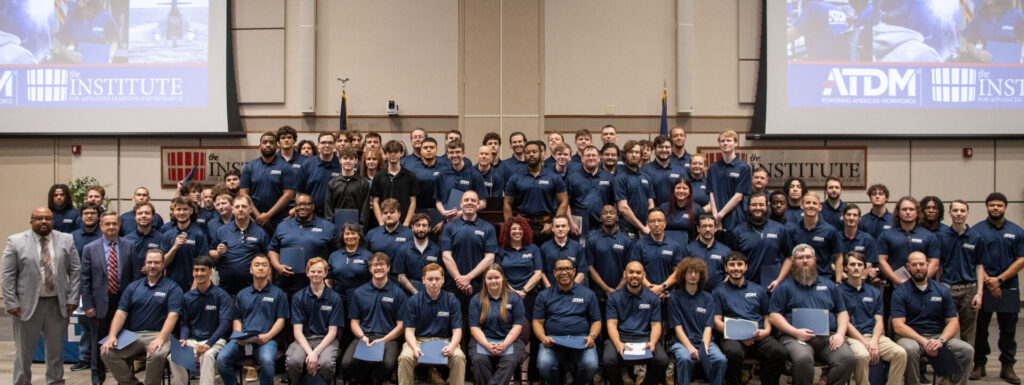
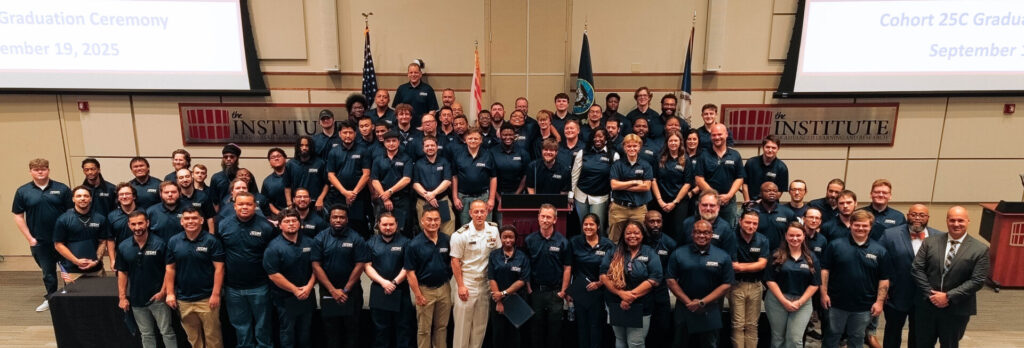
“I love hearing the ‘why’ of the students who choose to attend ATDM,” said Jason Wells, IALR’s Executive Vice President of Manufacturing Advancement. “We have seen adults of all previous career experiences and education levels graduate from this program and launch successful manufacturing careers that ultimately support our national defense.”
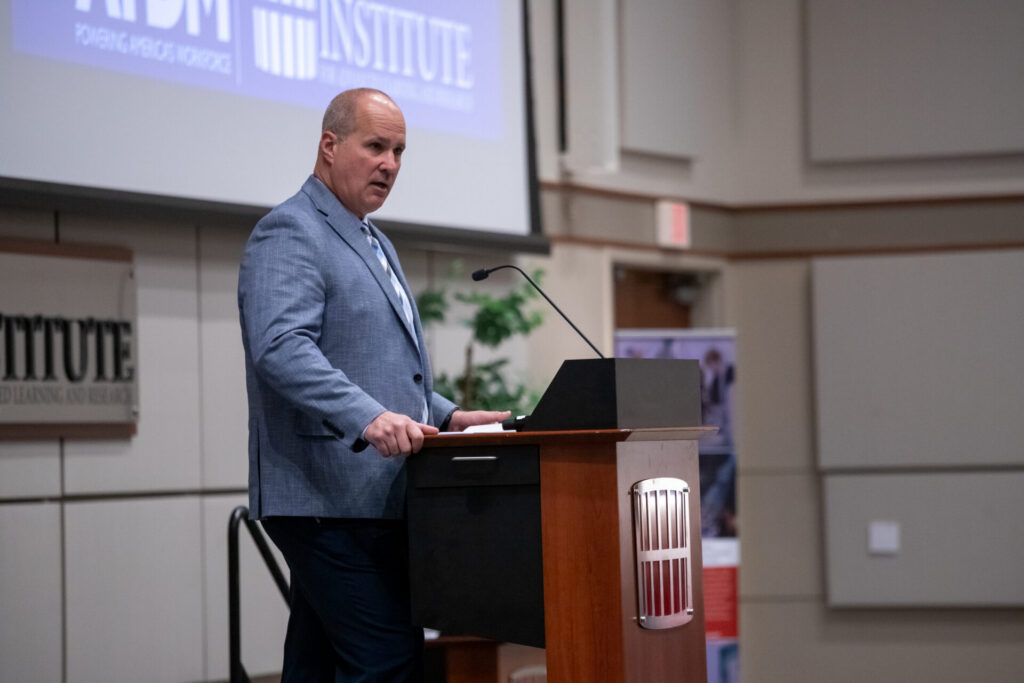
IALR’s Executive Vice President of Manufacturing Advancement, Jason Wells, speaks during a recent ATDM graduation.
Accelerated Training without Barriers
Our nation’s defense faces a monumental challenge: to meet production needs for submarines, aircraft carriers and other naval vessels, an estimated 10,000 skilled trades professionals must enter the submarine industrial base (otherwise known as the SIB) every year for the next decade. Traditional pipelines can’t scale fast enough.
ATDM was created to help meet that need.
First launched as a pilot program in 2020 and now scaling up to full operational capacity, ATDM compresses years of training into a 16-week, 600-hour program that prepares adult learners for immediate employment within the SIB.
“By taking highly motivated individuals and putting them through an intensive 16-week training program, a defense manufacturing boot camp, ATDM is closing the workforce gap at a pace that traditional pipelines have not been able to match,” said Vice Admiral Robert Gaucher, Director of Submarine Programs.
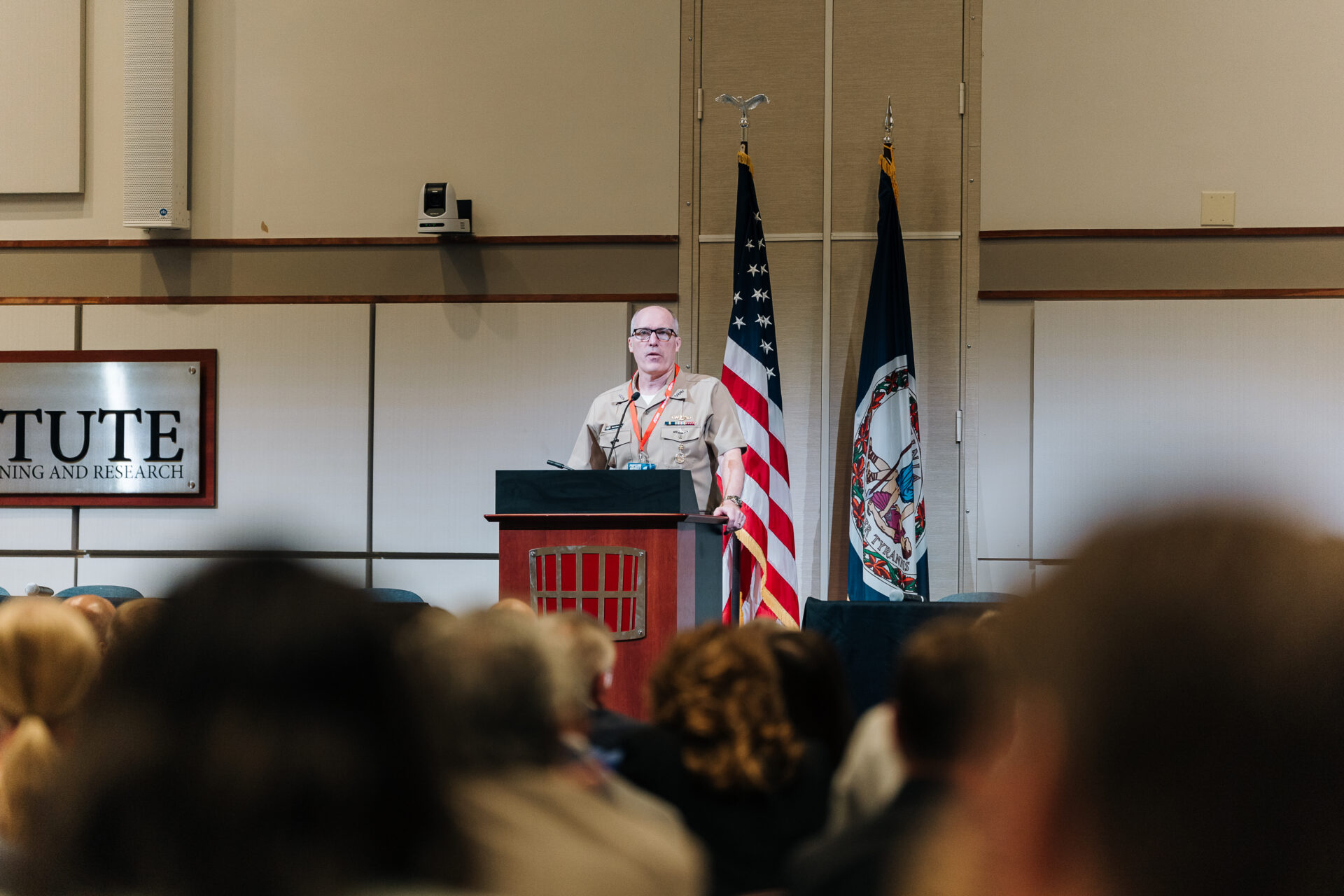
Vice Admiral Robert Gaucher, Director of Submarine Programs, speaks during the recent ATDM Maritime Workforce Forum.
Students train in one of five high-demand tracks.
| Welding | Non-Destructive Testing | Quality Control | Additive Manufacturing | CNC Machining |
Each of these tracks is fast and focused, ensuring that students learn the skills and soft skills they will need to succeed in their new roles.
Throughout their four months in the program, these students are connected with companies actively hiring for positions that match their exact skill set. Every ATDM student attends two on-site career fairs with dozens of employers during their time in the program.
What makes ATDM unique is that all cost barriers are removed. Students do not have to pay for tuition, the furnished housing that they live in during their four-month stay, or even transportation to and from class every day.
The complete lack of cost barriers and the program’s speed allow people of all types, from recent high school graduates to those who are dissatisfied in their current career path, to give up four months to prepare for and step into a new career.
ATDM Graduates By the Numbers
| Age Range | Percentage of Graduates |
| 18-21 | 30% |
| 22-30 | 26% |
| 31-40 | 22% |
| 41+ | 13% |
| Not Indicated | 9% |
A Way for Veterans to Continue their Service
From the beginning, one of the primary target recruitment audiences for the ATDM program has been veterans of the U.S. military. Their discipline and sense of purpose make veterans a natural fit for defense manufacturing careers as they transition out of the military and into civilian life.
Originally from Southeastern North Carolina, Robert Johnson served a five-year term with the U.S. Navy as a quartermaster. When he transitioned out of the military in 2019, he began doing security work, including at Newport News Shipbuilding — a place where many ATDM graduates find manufacturing careers.
Johnson received a flyer for ATDM from his girlfriend, who was transitioning out of the military, in 2024, and Johnson decided to give it a shot.
“I liked that they had hands-on training that led directly into a skilled trade job,” he said.
Upon completing the program in June of 2024, Johnson applied to work with Advex in Hampton Roads. He started as a CNC operator but, within 5 months, stepped into a CNC machinist role.
“You go and set your tools, get your parts and materials, get it all in the machine, load the program, make chips and try to keep everything in tolerance,” Johnson said of his day-to-day role for which ATDM prepared him.
Approximately 16% of ATDM graduates to date are veterans.
Hands-On Careers for Those with College Experience
The only education requirement for ATDM students is a GED or high school diploma.
But that doesn’t mean that those with college experience or degrees don’t decide to participate in the program as a fast track to switch into more hands-on career paths. Approximately 12% of graduates have college degrees.
Cedric Bond and his older brother, Ethan Bond, had degrees and careers in very different fields: Cedric Bond had a mechanical engineering degree but was doing office work; Ethan Bond had a business degree and had spent six years working in sales and marketing.
“I was tired of work that can have four people look at the same work, and everyone has a different opinion on the level of that work,” Ethan Bond said. “And I wanted something hands-on, where it’s either good or it’s bad, it’s clear.”
When they learned about ATDM, both decided to move from Colorado to Danville for the four-month training program, and now both are working in very different roles at Newport News Shipbuilding. Cedric is a nuclear engineer doing refueling operations, and Ethan is a welder.
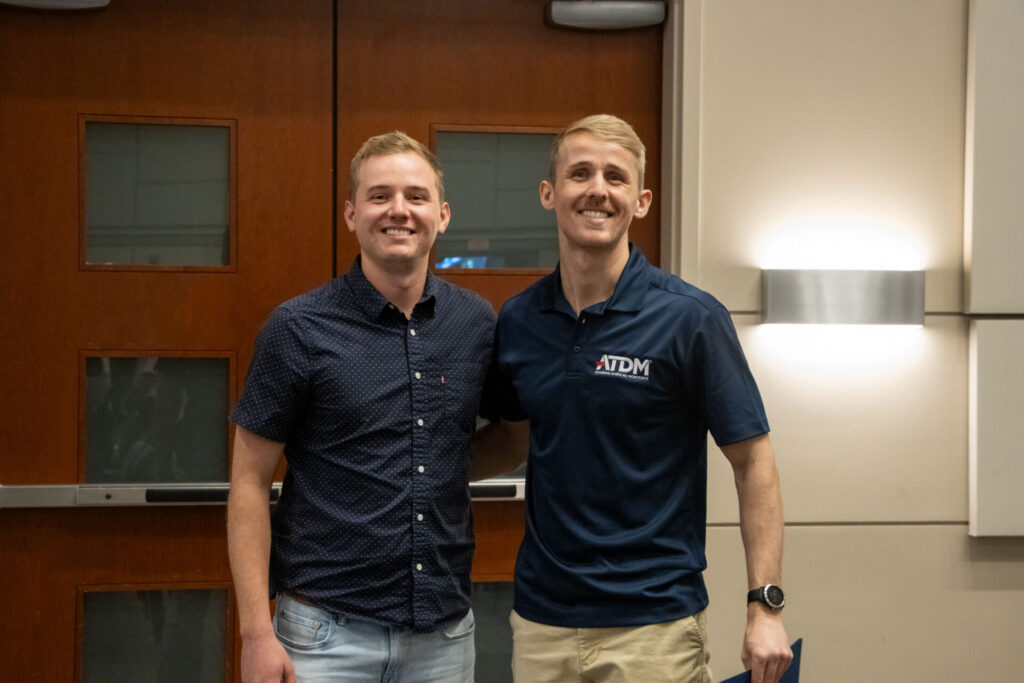
Cedric Bond (left) and Ethan Bond (right), both with college degrees and previous career experience, chose to complete the ATDM program. They both now work at Newport News Shipbuilding.
“My goal was to continue on in the engineering field, and I saw CNC machining would be the most beneficial,” Cedric Bond said. “ATDM helped make me an excellent engineer and have that mindset of how things are actually made. You can design something, but if you don’t actually have the idea of how it’s being made, it won’t turn out very well.”
Lauren Rice, who graduated from ATDM just a week after Cedric Bond, had also attended college studying psychology and engineering, but she could tell it wasn’t right. An internship that she thought should have been fulfilling showed her that she needed something tangible and hands-on.
“I would sit at a desk all day, and I didn’t like that,” she said.
She considered other options, including joining the military, but her older brother (himself an ATDM graduate) persistently encouraged her to enroll in the program. She, along with her younger brother, decided to give it a shot.
And her four months of additive manufacturing training weren’t easy.
“The stakes are high,” Rice said. “This isn’t a game. You really have to put in the work to stay here. I am really proud of myself for being able to finish.”
After graduating, Rice landed in Colorado working as a machine technician with Big Metal Additive, a smaller Navy supplier that consistently hires ATDM graduates.
From Unfulfilling Jobs to Moving Up
Almost everyone who decides to take a chance on a four-month program like ATDM has something important in common: they are all unfulfilled in their current career path and ready for something new. That’s the story of Shamel Fitzgerald and Michelle Cruz in a nutshell.
After high school, Fitzgerald did a mix of jobs, primarily driving trucks in furniture and moving operations. He knew he didn’t have a career, but he also didn’t know what else to pursue.
Then his sister went through ATDM as part of the first cohort in 2020. Fitzgerald saw firsthand that the program could place him on a path to a successful manufacturing career, so he enrolled.
“I gave up my job, apartment, and just took a chance and moved to Danville,” he said.
He learned the ins and outs of additive manufacturing over four months and then landed a job, along with another classmate, at Beehive in Knoxville, Tennessee. In the years since, he has been promoted to senior additive technician and is currently undergoing training to be the lead additive technician.
“So I can run all of the industrial 3D printers for the company, touching just about every part that leads to a customer,” Fitzgerald says.
Five years later, he can’t help but feel grateful for the impact ATDM made on his life.
“I’m working with a multimillion-dollar company,” he said. “I’m in charge of multimillion-dollar machines, and I get a lot of respect from my peers because I know the job very well. And ATDM is a big part of that because they put the seed in my head to get me going on this path, and I just flourished once I got here.”
Like Fitzgerald, Michelle Cruz had spent years in various jobs that weren’t particularly fulfilling or high paying; her experience was primarily in retail and as a school bus driver.
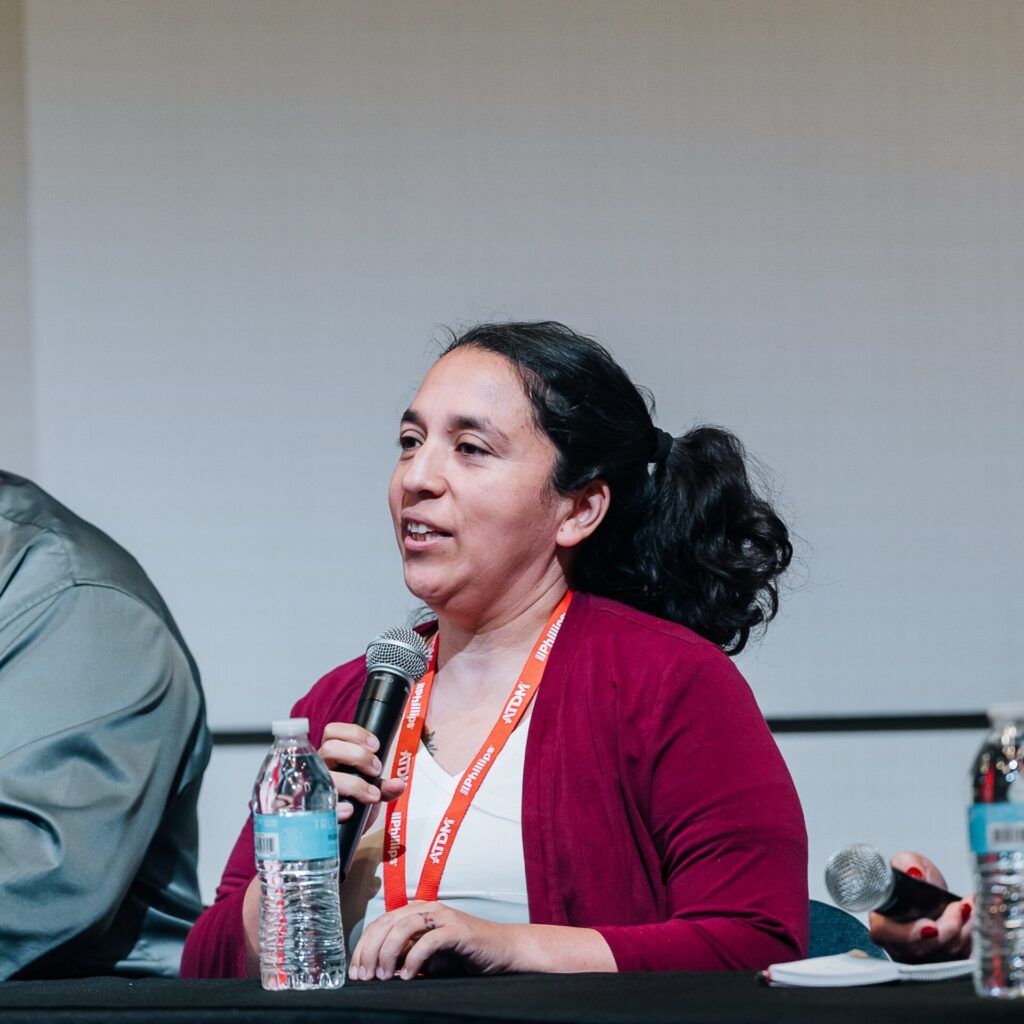
Michelle Cruz, a 2025 non-destructive testing ATDM graduate now working at Trident Refit Facility, speaks during the recent ATDM Maritime Workforce Forum.
When she found out about the ATDM program, she was living in a hotel with her family. She knew something needed to change, so she decided to take a chance by enrolling in the non-destructive testing track. After enduring difficulty and insecurity about whether she could complete the program and succeed in an NDT career, Cruz graduated from ATDM in the summer of 2025 and stepped intoan NDT inspector role at Trident Refit Facility in Georgia.
“In four months, you can have something that no matter how old you are, you can do it for the rest of your life,” Cruz said of the ATDM experience.
Motivated Workers Upskilled for Their Company
To date, the majority of participants in the ATDM program are classified as career-seekers: they show up to the program without a job already lined up and interview with companies during their time in the program. Many of them find their next job well before their graduation date.
That’s not the only path for people to attend ATDM, however.
Companies in the submarine industrial base can hire someone without experience, provided they complete ATDM before coming to work.
Companies can also send current employees to upskill them.
That’s exactly how Mark Tansey and Sam Medina, both from the Philadelphia area, ended up going through the ATDM program sponsored by Kingsbury Inc.
Tansey, who went from working in the metal fabrication shop to “running machines all day,” said ATDM fully equipped him for that upward career move.
“Anything I use in the shop, I learned there at ATDM, whether it’s calculating speeds or feeds or monitoring tool wear,” Tansey said. “ATDM prepared me fully for my day-to-day.
Medina arrived at Kingsbury with previous culinary experience, time spent as a bodyman fixing cars and a term with the U.S. Marines. While working for Kingsbury as a babbitter, Medina would visit the weld shop and quickly developed an interest. After hearing about ATDM from a Navy Admiral during a visit to the Philadelphia shipyard, Kingsbury sponsored his ATDM welding training in 2023.
“My instructors challenged me to think and approach welding in different ways,” Medina said. “I’ve always remembered some of the things that they’ve said to me.”
But just becoming a welder isn’t where his career journey ends.
Medina was recently promoted to a quality engineering role, where he can use his welding experience to standardize processes. That combination gives him a perspective many organizations struggle to develop: someone who understands production realities and quality requirements from lived experience.
“Understanding the welding side of it is extremely helpful to the position that I’m in,” he said.
With scholarships that cover world-class accelerated training, as well as housing, the program is open to adults ready to launch a career with impact. The tools are there to ensure success.
“If you put your head down and do it, I mean, there’s absolutely no excuse not to be successful doing this program,” Medina said. “The fact that the Navy takes care of you for housing and education, I mean, you should strive to be number one in the class.”
For adults who already have families, have previous career experience and have more riding on their success, the idea of changing everything and enrolling in ATDM can feel intimidating.
As Tansey said, borrowing some language from the CNC shop, “You can’t be afraid to hit cycle start.”
