“We use scientific methods to determine the structural integrity of everything.”
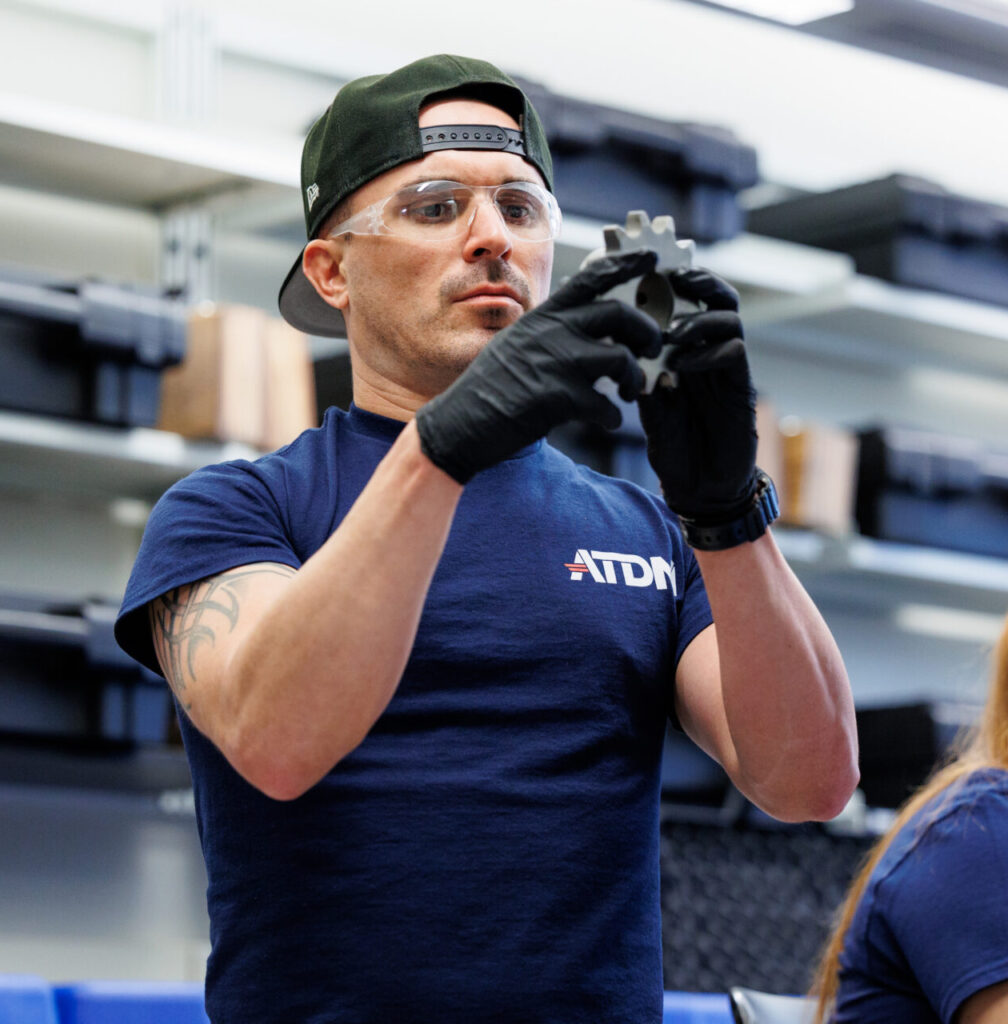
That’s how Justin Schmidt, a Non-destructive Testing (NDT) instructor with the Accelerated Training in Defense Manufacturing (ATDM) program, explains the process of NDT.
As the name implies, NDT is the science of inspecting materials, components or structures without damaging them. It’s a field that combines hands-on techniques with high-tech equipment, logic with intuition and plenty of math. And it’s a cornerstone of quality control and assurance across defense, aerospace, automotive, energy and infrastructure industries.
From weld seams to forged metal parts, from pressure vessels to precision-machined components, Schmidt and the other NDT instructors train students to uncover the hidden flaws that others can’t see and might not even think to look for.
“We are the people who tell manufacturers whether their work meets the standard,” Schmidt said.
In other words, NDT technicians ensure the quality of things that are made and safeguard lives. NDT professionals evaluate materials that are critical to everyday life, from bridges to roller coasters to submarine components to cellphones.
“We are the backbone of the quality of industries. We protect industries and we maintain standards.” – Christopher Carter, ATDM NDT Instructor
Adult learners who enroll in ATDM can learn the skills needed for a meaningful, high-paying NDT career in just four months.
What Is Non-destructive Testing?
At its core, NDT involves using a range of techniques to evaluate the integrity of a part or material without altering the part. It’s sometimes also referred to as Non-destructive Examination (NDE) or Non-destructive Inspection (NDI).
These tests can detect surface cracks, internal cracks and voids, improper welds or differences in material density. NDT and metrology (the science of dimensional measurement) are critical aspects of quality control. Whereas metrology focuses on the dimensional quality of the part (ensuring it is the exact size and shape it is supposed to be), NDT focuses on the part’s integrity, both on the outside and inside.
In most cases, these inspections happen at multiple times during material processing, such as when the raw material arrives, after machining or welding and before the final part leaves the shop floor and is sent to the customer.
There are five primary NDT processes that ATDM students learn:
Visual testing is the simplest and most fundamental form of NDT. Technicians use tools like magnifying glasses and common hand tools to examine surfaces thoroughly. This method identifies visible defects such as cracks, corrosion, deformation or any irregularities that could compromise structural integrity.
Liquid penetrant testing is ideal for identifying surface-breaking flaws that might be invisible to the naked eye. A colored or fluorescent dye is applied to a material’s surface, penetrating any tiny cracks or defects. After removing excess dye, a powder developer is used to reveal defects clearly under visible or ultraviolet light.
Magnetic particle testing is specialized for ferromagnetic materials like steel and iron. Technicians magnetize the material and sprinkle iron particles over the surface. Flaws disrupt the magnetic field, causing particles to cluster around them, clearly indicating locations of defects that could affect structural strength and reliability.
Ultrasonic testing uses high-frequency sound waves to detect internal defects or to measure material thickness. A transducer sends sound pulses into the material, and any echoes returning from internal defects are displayed on a screen for the technician to analyze. This precise method allows technicians to visualize internal issues such as voids, inclusions and cracks.
Radiographic testing is comparable to medical X-rays. It involves passing X-rays or gamma rays through a component to produce an image on film or a digital detector. Variations in density and thickness appear on the resulting images, clearly highlighting internal defects such as cracks, porosity or inclusions.
Instructor Chris Carter notes, “Any time you have a break in density, it will show you a different material layout.”

ATDM: Preparing Technicians in Just Four Months
In traditional paths, mastering these skills takes years. However, the ATDM program prepares motivated adult learners in 600 hours of training over just four months.
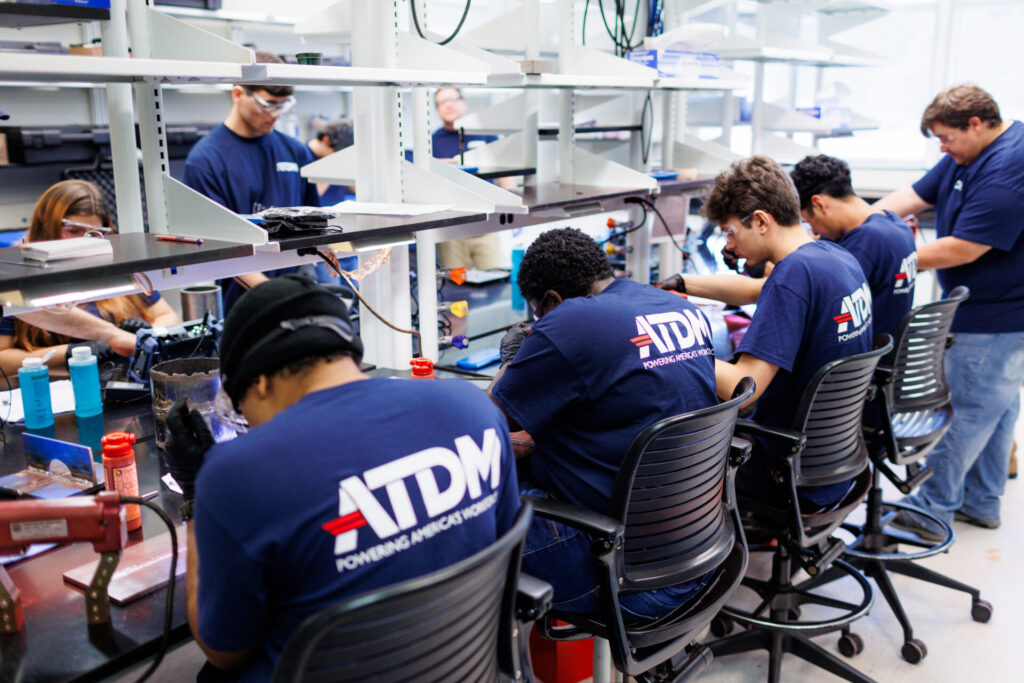
Based at the Institute for Advanced Learning and Research (IALR) in Danville, Va., ATDM is a full-time, immersive training initiative supported by the U.S. Department of Defense. Students from all over the United States come to Danville to train using industry-standard tools and advanced technologies that simulate the exact work they’ll perform in the field.
The program provides scholarships that cover tuition and housing costs, removing financial barriers and making this career path accessible to motivated learners nationwide. Students have come from 47 states and have found meaningful careers in 37 states. More than 900 students have completed the program to date.
Graduates of ATDM’s NDT track earn industry-recognized training qualifications and go on to work across the Maritime Industrial Base (MIB), protecting critical infrastructure and ensuring national security.
Join the Program
Are you interested in launching a meaningful, in-demand career? ATDM is seeking dedicated individuals ready to make an impact. If you work well with pattern recognition and have a knack for learning new technical skills, join the next class of ATDM learners and become an NDT professional in just four months.
Hire Skilled NDT Graduates
Companies in the Maritime Industrial Base (MIB) need qualified NDT professionals to meet quality and safety standards. ATDM graduates are trained and certified in key NDT methods, ready for immediate integration into your workforce.
Train NDT Students
As demand for skilled NDT technicians grows, ATDM is expanding its instructional team. Experienced professionals interested in shaping the future of defense manufacturing are encouraged to apply to the open NDT Instructor and NDT Technician roles. These roles involve hands-on teaching, student advising, lab management and curriculum development on-site in Danville, Va.
Candidates ideally bring extensive industry experience, hold ASNT, SNT-TC-1A, or NAS-410” certifications, and have a passion for mentoring the next generation.