When biosystems engineer Luis Huezo, Ph.D., launched FermentSystems, he wasn’t looking to build a laboratory from the ground up.
Instead, Huezo chose to base his new bioprocess consulting firm on the Institute for Advanced Learning and Research campus, tapping into shared infrastructure, specialized equipment and a collaborative environment designed to help companies move quickly from idea to execution.
That approach allowed FermentSystems to begin operating much more quickly, offering fermentation and bioprocess development services to clients across Virginia and beyond.
“IALR has an infrastructure already in place,” Huezo said. “There’s a chemistry lab, greenhouses, all types of infrastructure already here that make it easier for an entrepreneur to come in and start a business.”
FermentSystems now serves as yet another example of how early-stage companies can utilize IALR’s Applied Research division as an accelerator and a technical partner, accessing high-end research tools without the capital burden of building and equipping an independent facility.
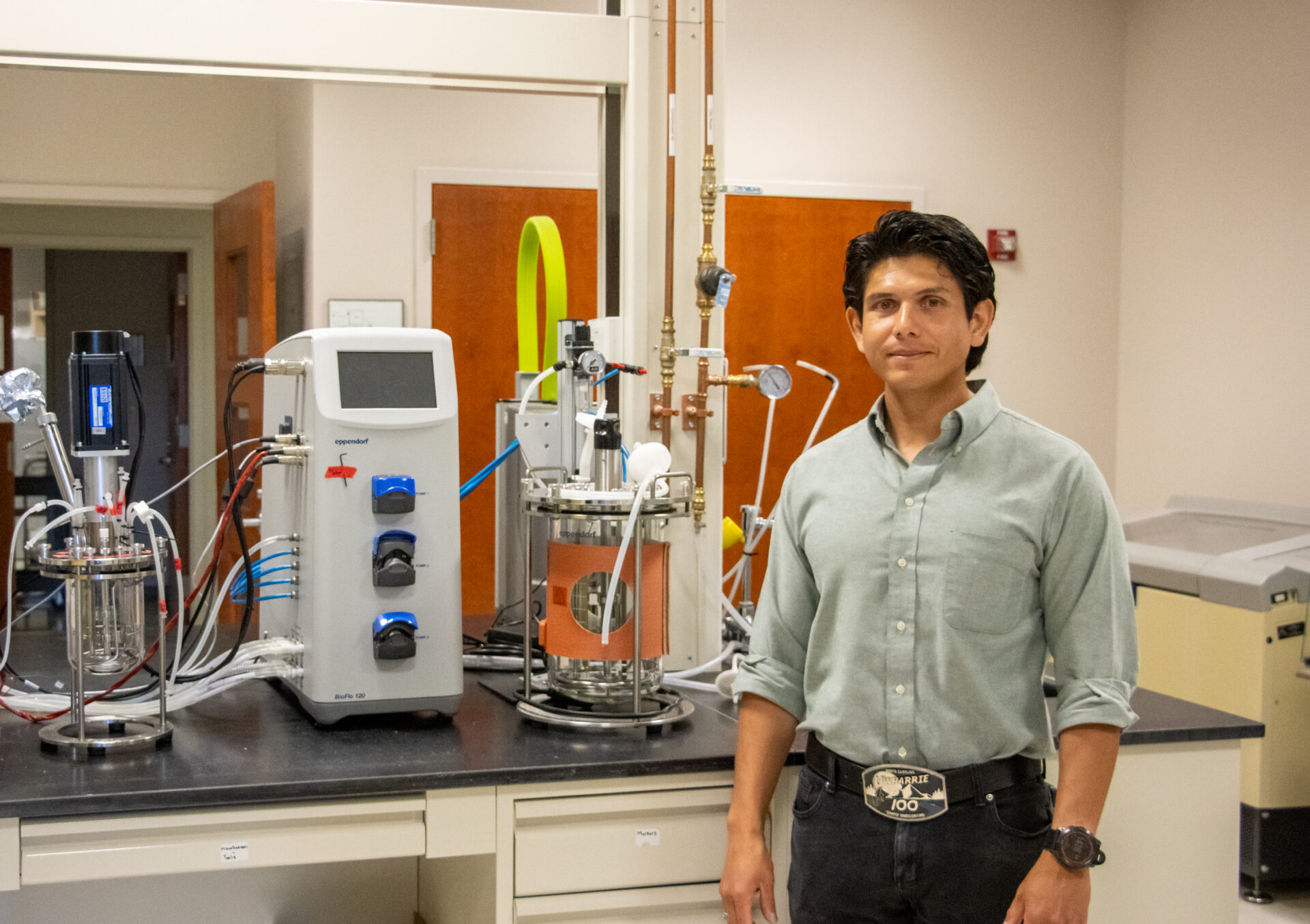
Luis Huezo, Ph.D. with the Eppendorf Bioflo 120.
From Idea to First Batch
FermentSystems is a technical consulting firm that helps companies develop biological products through fermentation and bioprocess engineering. Huezo works with clients who have a concept, such as producing a protein or biologically derived material, but lack the equipment or expertise to test and refine the process.
“It’s a technical consulting company for fermentation and bioprocessing,” Huezo said. “The idea is to provide fermentation process development and bioprocess engineering, along with techno-economic and sustainability analyses.”
The company supports clients across microbiology, fermentation, downstream processing and feasibility analysis, combining experimental data with modeling to assess whether a concept can scale commercially.
“Usually when companies want to produce something, they want to have a small batch they can take to investors,” Huezo said. “But to get to that first batch, you have to develop and validate the process. And that’s what we’re trying to do.”
FermentSystems focuses on early-stage process development rather than manufacturing, helping clients reach pilot-scale readiness and make informed technical and business decisions.
Shared Equipment Accelerates Startup Timelines
By locating on the IALR campus, FermentSystems gained access to bioreactors and laboratory facilities already in use for workforce training and applied research.
The bioreactor systems are the same equipment used during IALR’s annual industrial fermentation workshops, which bring together students, faculty and industry professionals for hands-on training.
That shared-equipment model dramatically shortened the company’s startup timeline.
“It’s been three weeks since I moved in, and I’m setting up the reactors to start my first runs,” Huezo said in mid-April. “If I went to a different place with no equipment, it would take much longer just to get the reactors.”
IALR’s Applied Research division offers similar flexibility to other companies on campus, with tenants able to utilize laboratory benches, desk space, greenhouse facilities, SMART Platforms and specialized labs based on their needs.
“Every company faces unique challenges. We pride ourselves on offering customized research services that address specific goals, whether you’re an emerging startup or a global enterprise.” – Scott Lowman, Ph.D., Vice President, Applied Research, IALR
Part of a Growing Innovation Ecosystem
FermentSystems is one of approximately 20 businesses and organizations with a permanent presence on the IALR campus — a mix that includes entrepreneurs, large manufacturers, workforce partners, economic development organizations and legacy educational institutions.
Seven companies currently lease space within Applied Research alone, ranging from early-stage ventures to established companies such as Canon Virginia.
That density of varied organizations creates an accelerator ecosystem, where companies benefit not only from facilities but also proximity to expertise, talent and potential collaborators.
“I see it as an incubator environment,” Huezo said. “The reactors are here. The equipment is here. I need to provide chemicals and consumables, but it would be 10 times more difficult to start from zero in another building.”
Huezo said locating FermentSystems on campus also aligns with IALR’s broader economic development mission.
“By starting a company, the idea is to bring projects and collaborations here,” he said. “That is all reflected back to IALR, because one of its goals is economic development in the area.”
As FermentSystems grows, Huezo hopes to contribute to the expansion of fermentation and bioprocessing capabilities at IALR — further strengthening the campus as a launch point for applied research companies.
“Hopefully putting Danville in a position where people would think, ‘Danville —that’s where fermentation happens’” he said.
