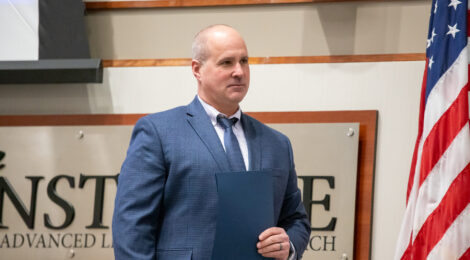
By Jason Wells, Executive Vice President of Manufacturing Advancement, IALR
The recent Southern Virginia Living Wage and Job Availability Study shows that more manufacturing workers are available than manufacturing job openings across GO Virginia Region 3.
At face value, that suggests a surplus of workers.
But that’s not what our team hears when talking with manufacturing companies across our region, whether it’s a metalworking shop in Halifax or a major defense supplier scaling production.
What I hear is: We can’t find enough people with the right skills.
So which is it? Are we long on manufacturing talent or short on it?
As is often the case in workforce development, the truth lives in the tension between the two.
And this tension is exactly why our region cannot simply focus on technical skills alone. Readiness also depends on communication, reliability, professionalism and work ethic — the difference between being job‑oriented and being truly career‑minded.
It’s not just about the number of workers. It’s about who they are, where they live and what they’re prepared to do.
When the Data and Reality Don’t Match, Look Closer
The report’s regional snapshot captures job postings at a moment in time. But manufacturing doesn’t behave like some other sectors. A firm may have robust headcount on paper and still feel understaffed because:
- Skills mismatch: Available workers lack the specific technical competencies modern manufacturers require.
- Experience shortage: Open roles often require mid‑ to senior‑level experience that entry‑level candidates don’t yet possess.
- Geographic gaps: Workers and job openings are not located in the same regions, limiting access.
- Compensation & shift misalignment: Wage expectations, shift schedules and workplace flexibility don’t always align with candidate preferences.
- Outdated industry perception: Misconceptions about manufacturing reduce interest in entering the field.
- Workforce participation barriers: Available workers may face transportation, childcare, housing or readiness challenges.
- Credential inflation: Overly rigid job requirements narrow the qualified candidate pool.
- Rapid technological change: Training pipelines lag behind fast‑evolving manufacturing technologies.
- Retention issues: High turnover sustains hiring demand even when applicants exist.
- Demographic pressure: An aging skilled trades workforce with limited replacement pipeline.
Another dynamic is hiring itself: many employers continue using the same recruitment practices while expecting different results. Hiring needs to evolve just as manufacturing evolves, and too often, it hasn’t.
In other words, a surplus on a spreadsheet doesn’t always translate to a talent pool at the door.
And employers will tell you that directly. Many are balancing production deadlines with training gaps, or they’re promoting inexperienced technicians into advanced roles simply because there’s no one else in the pipeline.
That’s a skills‑alignment problem rather than a surplus problem.
Geographic Variation Matters
GO Virginia Region 3 is large, stretching from Patrick County eastward toward the Richmond frontier. The study’s macro view smooths over significant variation.
Some localities genuinely have more manufacturing workers than openings. Others, especially those closest to emerging industrial sites, already feel tight.
This regional imbalance shows up in workforce conversations every week. A plant manager in one county may be turning away applicants. Another, 40 miles away, may be struggling to hire despite higher wages.
Without strong networks intentionally linking people to jobs, employers to training providers and communities to each other, surplus and shortage can exist side by side.
For manufacturers evaluating expansion or relocation, this alignment signals regional capability. They are not simply assessing today’s headcount; they are evaluating whether the region can mobilize talent, scale training and collaborate across boundaries when opportunities arise.
The Future Will Not Look Like the Present
If we only plan for the present, we’re already behind.
Already, we know of two major manufacturing plants on their way to Southern Virginia. Microporous announced in November of 2024 that it will create a $1.35 billion battery separator manufacturing facility at the Southern Virginia Megasite at Berry Hill. And just this month, Avio USA Inc. announced a $500 million new solid rocket motor manufacturing facility to be located at the Southern Virginia Multimodal Park in Hurt.
Together, these two projects will create more than 3,000 jobs, with the vast majority in manufacturing.
These projects are fundamentally reshaping the demand curve in Southern Virginia. And they are not the only ones. Over the past several years, our region’s manufacturing ecosystem has steadily expanded in capability, technology and national visibility.
I am confident more announcements will come.
Today’s surplus could become tomorrow’s severe shortage.
In manufacturing, the lead time to develop talent is long. You don’t train a CNC machinist, quality technician or AM operator in a few weeks.
This is part of why employer conversations feel so different than the report’s topline numbers. Businesses are looking to prepare their workforce for future capabilities, production demands and contracts.
Why Skills Gaps Persist Even in Surplus Conditions
During conversations with industry partners, one theme comes up constantly: “We have applicants. We need contributors.”
Manufacturing requires technicians who understand not just how to run equipment, but how processes flow, how tolerances stack, how documentation supports quality and how automation integrates with upstream and downstream operations. Those capabilities don’t appear automatically in the workforce just because workers exist.
Skills gaps arise because:
- Technology has outpaced traditional training pathways.
- Many workers have experience, but not in today’s advanced manufacturing environments.
- Employers increasingly need talent who can operate in hybrid systems: data‑enabled machining, additive + subtractive workflows, automation cells, Industry 4.0 ecosystems.
As my team engages with manufacturers in the region and across the nation, we repeatedly hear those exact needs for employees who can contribute at a high level faster than ever before.
This is Exactly the Gap IALR Was Built to Close
Across our campus, we have deliberately aligned our programs around the skills‑to‑production pipeline, from early-career exploration to advanced, hands‑on training to real‑world technology adoption.
Our Accelerated Training in Defense Manufacturing (ATDM) program takes what is traditionally a year and a half of focused training and condenses it into an intense, disciplined 16‑week experience. Graduates leave with foundational technical competency, hands‑on repetition under pressure, and a mindset oriented toward excellence and urgency.

This kind of talent pipeline directly addresses employers’ requests for speed, reliability and readiness.
We also know that readiness begins early. The Great Opportunity in Technology and Engineering Careers (GO TEC) program exposes middle schoolers to welding, machining, robotics and other pathways long before they step into high school CTE or dual‑enrollment programs.
The Integrated Machining Technology program, which is taught by Danville Community College and housed at IALR, gives emerging technicians the “third-year” experience where all the pieces finally come together.
And our partnership network ensures those pathways form a cohesive ladder, not a scattered series of steps.
From Skills Gaps to Strategic Opportunity
If you zoom out, a pattern emerges.
Yes, the report shows a surplus of manufacturing workers today.
And yes, employers are sounding the alarm about skills gaps today.
But tomorrow’s picture is already taking shape:
New industrial employers are coming.
Existing employers are expanding.
Advanced manufacturing technologies are accelerating.
The region is being asked to produce more, faster and with greater precision.
The question isn’t whether we have enough people.
It’s whether we have enough prepared people in the right places, with the proper training, aligned to the right future.
And that brings me back to something I shared recently with our entire Manufacturing Advancement team:
“When the rate of change outside exceeds the rate of change inside, the end is near.” — Jack Welch
Manufacturing is living that reality every day. The pace of external change — new employers, new technologies, new federal expectations, new supply‑chain vulnerabilities — is accelerating. If our talent systems, training pipelines and regional partnerships don’t evolve at the same speed, we won’t just fall behind. We’ll miss the moment entirely.
Southern Virginia, however, is choosing a different path.
We are choosing to change faster.
To prepare sooner.
To build forward.
IALR’s mission has always been to serve as a forward-looking catalyst. And the work happening across our campus today, from ATDM to IMT and GO TEC, is positioning this region not only to meet the demands ahead, but to lead in ways few would have predicted a decade ago.
We’re not preparing for the workforce or the job count we have today.
We’re preparing for the workforce we will need tomorrow
Jason Wells is IALR’s Executive Vice President of Manufacturing Advancement. With decades of experience in the toolmaking industry, Wells now leads IALR’s manufacturing training and optimization efforts.