Click to read full interactive newsletter
Institute for Advanced Learning and Research
Driving Economic Transformation
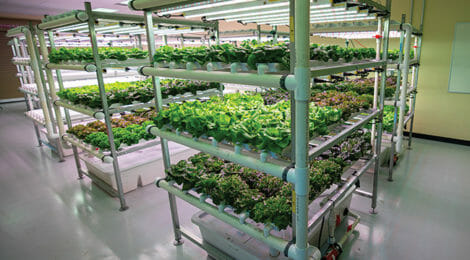
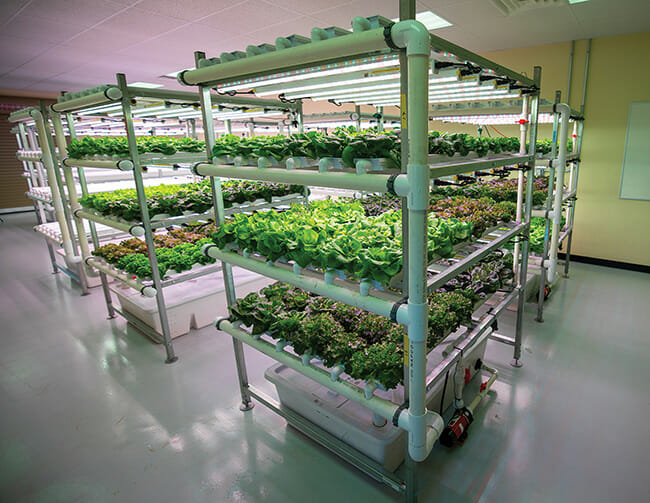
Hydroponic lettuce is one of the plants undergoing research at the CEA Center, which combines engineering, plant science and computer-managed greenhouse control technologies.
IALR and the Virginia Tech Center for Economic and Community Engagement received a grant to help grow the Controlled Environment Agriculture (CEA) sector in GO Virginia Region 3. The $77,053 grant will fund development of a strategy and roadmap for supporting industry growth and workforce development for CEA throughout the region. The effort will include an analysis of this emerging and dynamic agribusiness sector, including its industry and economic growth potential, while identifying needed facilities and infrastructure, workforce development issues, opportunities and applied research assets.
“A key outcome of the study will be to identify future needs and opportunities to support controlled agricultural production facilities and the underlying business investment for use by local and regional economic development and workforce development organizations and professionals,” said IALR Director of Applied Research Dr. Scott Lowman.
Controlled Environment Agriculture is an opportunity to attract and expand agribusiness investments. For instance, AeroFarms recently broke ground on a $53 million investment to build one of the largest aeroponic vertical farms in Danville. Nearby on IALR’s campus resides the focal point of the grant initiative, the Controlled Environment Agriculture Innovation Center, which is a partnership with Virginia Tech’s School of Plant and Environmental Sciences.
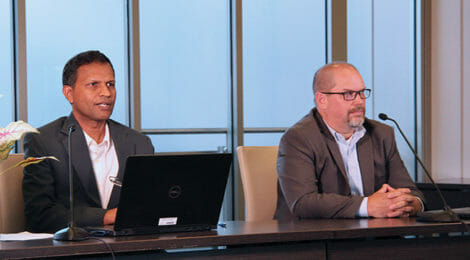
IALR held our second plant endophyte webinar featuring Dr. Sajeewa Amaradasa joined by Dr. Scott Lowman, Director of IALR’s Applied Research department. Dr. Amaradasa presented on “Exploring the Potential of Beneficial Bacterial Endophytes for Disease Control,” which explained how plant endophytes can serve as biological control agents. Participants gained knowledge of this fascinating topic during the webinar, which concluded with a live question-and-answer segment. Watch the full presentation at endophyteresearch.com.
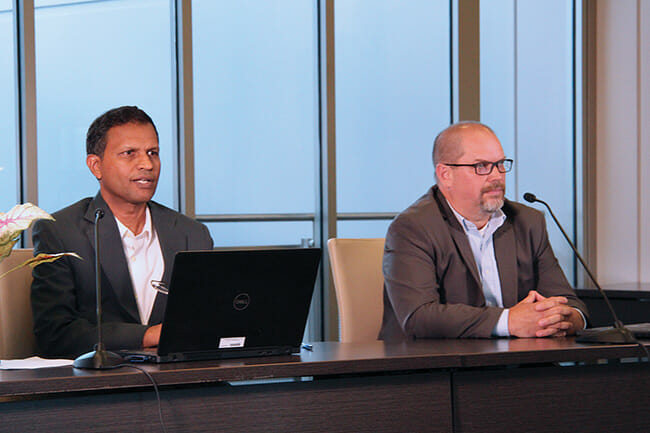
Dr. Amaradasa (left) and Dr. Lowman (right) discuss IALR’s plant endophyte research during a webinar; IT, Communications, conferencing staff and the Research team contributed to this webinar, which is one of a series.
Within the presentation, participants learned how endophytic bacteria isolated from natural habitats are screened for biocontrol of plant diseases. IALR houses a library of more than 2,000 endophytes that are rapidly assayed in vitro and tested for commercial value in the greenhouse and field. These endophytes, which have been identified by members at the Plant Endophyte Research Center of IALR, provide new business opportunities. They also offer chances for further collaboration with universities for setting agricultural technology trends. The members of this research center include Lowman, Director; Dr. Chuansheng Mei, Chief Scientist; Robert Chretien, Laboratory Research Associate; Amy Turner, Laboratory Research Associate; and Amaradasa, Scientist.
One of the newest collaborative opportunities for this research center has been presented by the Virginia Tech (VT)-IALR Controlled Environment Agriculture Innovation Center. This new indoor farming partnership with VT’s School of Plant and Environmental Sciences allows endophytes’ biocontrol properties to be tested for their ability to prevent plant disease in a controlled environment. To learn more about this initiative and research efforts, visit ialr.org/cea.
The presenter, Dr. Amaradasa, has extensive experience in studying fungal plant pathogens and has played an instrumental role in screening IALR’s in-house collection of endophytes for disease control in economically important crops. He obtained his Ph. D. from Virginia Tech and brings research experience as a former post-doctoral researcher for the University of Nebraska and Florida.