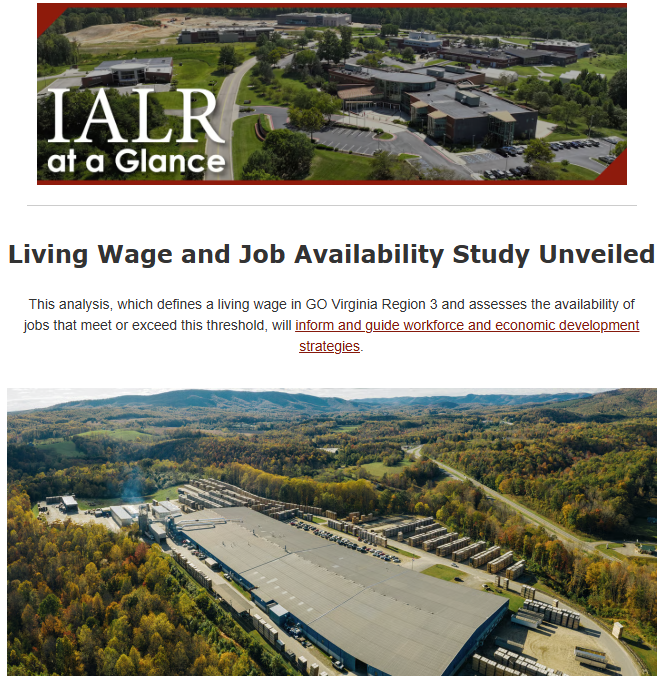
The November 2025 edition of IALR at a Glance is packed with exciting news and updates! Learn more about…
- More Companies are Hiring and Upskilling Talent with ATDM
- Featured Opportunity: Work at IALR
- Watch updates from IALR
- Much more!
Institute for Advanced Learning and Research
Driving Economic Transformation
The November 2025 edition of IALR at a Glance is packed with exciting news and updates! Learn more about…

~ Claude Moore Opportunities bringing together public and private sector stakeholders, including educational institutions and employers, to better align the region’s healthcare workforce development efforts and create career opportunities ~
As part of a new statewide initiative called the Virginia Partnership for Health Science Careers, a regional partnership in Southern Virginia will bring together schools, hospitals, healthcare providers, and workforce development professionals from the public and private sector to expand the area’s healthcare workforce, create meaningful career opportunities, and meet the needs of communities throughout Southern Virginia. The Southern Virginia Partnership for Health Science Careers will work to implement Collaborating to Address Regional Workforce Challenges: A Roadmap, an “off-the-shelf” guide to establish and operate regional, employer-engaged workforce development collaboratives in Virginia with a focus on healthcare careers.
The regional healthcare workforce partnership will be coordinated by Dr. Julie Brown, Vice President of Advanced Learning at the Institute for Advanced Learning and Research (IALR), and involve partners including Sovah Health, Sentara Halifax, PATHS, VCU Health Community Memorial Hospital, GO Virginia Region 3, Southside Virginia Community College, Danville Community College, Patrick & Henry Community College, and Virginia Career Works South Central and West Piedmont regions, along with the region’s Community Service Boards. The partnership will serve communities including the cities of Danville and Martinsville; and the counties of Amelia, Brunswick, Buckingham, Charlotte, Cumberland, Halifax, Henry, Lunenburg, Mecklenburg, Nottoway, Patrick, Pittsylvania, and Prince Edward.
To support the partnership’s success, Claude Moore Opportunities has helped convene the needed regional stakeholders, provided financial support for the partnership and healthcare workforce development programs throughout the region, and its partners at the George Mason University Center for Health Workforce have provided data on current and expected healthcare workforce shortages in the region.
“At Claude Moore, we believe that coordinated, regional partnerships are the most promising approach for creating meaningful career opportunities while meeting the healthcare needs of our citizens and strengthening regional economies throughout Virginia,” said Dr. Bill Hazel, CEO of Claude Moore Opportunities. “We are proud to be part of a true collaborative effort that builds on the work that local officials have been doing for years and look forward to the positive impact that this partnership will have on families and communities throughout the region.”
“IALR is proud to serve as a convener in GO Virginia Region 3, activating The Roadmap developed by Claude Moore and the Secretary of Labor and replicating the successful Blue Ridge Partnership model,” said partnership coordinator Dr. Julie Brown (IALR’s Vice President of Advanced Learning). “Developing collaborative partnerships, driven through private sector engagement and focused on data-driven solutions, will enable us to collectively address our region’s healthcare talent needs.”
In addition to the regional partnership for Southern Virginia, partnerships have now been established in each region of the state as part of the Virginia Partnership for Health Science Careers, a new statewide effort led by Claude Moore Opportunities to better coordinate healthcare workforce development in communities around the Commonwealth. The network’s workforce development efforts will focus on the careers that create strong, accessible medical, dental, and behavioral/mental health systems such as technicians, assistants, and aides, with an emphasis on the positions that community leaders and healthcare providers identify as most critical for their region.
The Southern Virginia Partnership for Health Science Careers has already begun its work and held several regional meetings, while the overarching Virginia Partnership for Health Science Careers has held two statewide summits to share strategies and best practices.
According to a comprehensive 2023 study for the Virginia Health Workforce Development Authority, 102 of Virginia’s 133 localities are federally designated “Health Professional Shortage Areas” and 93 localities are “Mental Healthcare Professional Shortage Areas,” meaning about 30% of Virginians live in a community without a sufficient number of primary and behavioral healthcare providers.
Based on an analysis of active job ads performed by the], it is estimated that, in order to meet the community’s healthcare demands in Southern Virginia, the region needs:
Southern Virginia also needs 131 postsecondary health specialties teachers to train and educate the next generation of healthcare and life sciences workers.
The GMU Center for Health Workforce analysis found that the Commonwealth of Virginia as a whole needs:
The Commonwealth also needs 1,711 postsecondary health specialties teachers to train and educate the next generation of healthcare and life sciences workers.
The Roadmap was developed collaboratively by Claude Moore, Virginia Works, and Virginia Secretary of Labor Bryan Slater with input from stakeholders around the Commonwealth including public and private sector workforce and economic development professionals, educators, and major employers. It represents a significant new embrace of the “sector-based strategy” that is emerging nationally as a successful method of creating a larger pool of skilled workers to capitalize on a community’s strengths and meet its unique needs.
The keys to the success of The Roadmap’s approach are its emphasis on wide stakeholder engagement to ensure a region’s trainings and educational offerings match its needs, and the creation of flexible professional development opportunities with “on and off ramps” so that Virginians can take their education as far as they wish while staying engaged with the workforce.
The Roadmap was released in September 2024 to stakeholders who contributed to it and public and private sector partners who can benefit from its use including local workforce boards, economic and workforce development professionals and agencies, the Virginia Community College System, Chambers of Commerce, major employers, and more.
The strategies explained in the Roadmap are applicable to any industry or sector that requires concerted workforce development efforts with a specific focus on healthcare workforce because of Virginia’s considerable needs, the complexity of healthcare workforce development, and Claude Moore’s unique expertise in this area.

Registered Apprenticeship programs have traditionally been associated with building trades, such as plumbing and electrical, and service trades like cosmetology and barbering.
However, employers across Southern Virginia are rethinking how Registered Apprenticeship can serve new industries, showing that these programs are adaptable, accessible and effective.
With support from the Expanding Talent through Registered Apprenticeship (ExTRA) program offered by the Institute for Advanced Learning and Research (IALR), diverse businesses are launching customized apprenticeship programs to meet their unique needs.

Danville-based Kegerreis Digital Marketing launched apprenticeship programs in four non-traditional roles to expand their possible candidate pool. Red Oak Excavating in Charlotte County now runs the only Heavy Equipment Operator Registered Apprenticeship in GO Virginia Region 3 (which covers 15 localities across Southern Virginia) as a way to upskill current employees and grow their workforce. Both have leveraged resources and support from the ExTRA program to create and implement their programs.
“Employers across the region can rely on ExTRA for the thorough and ongoing support they need to create and grow effective Registered Apprenticeship programs.” – Natori Neal, IALR Apprenticeship Coordinator
A Registered Apprenticeship combines on-the-job training with related technical instruction. Apprentices earn a wage while learning and receive pay increases tied to acquired skills. Employers benefit by “growing their own” skilled workforce aligned with company culture and goals.
IALR’s ExTRA program helps employers register apprentices, develop training plans and connect with education and workforce partners. Businesses may also receive grant funding of up to $2,700 per apprentice per year to support the cost of related technical instruction.
Apprenticeship bridges the gap between education and employment in fields like construction, manufacturing, healthcare, information technology and more.
Funded by a nearly $500,000 Tobacco Revitalization Commission grant, the ExTRA program has played a vital role in expanding registered apprenticeship opportunities by supporting employers – as evidenced by the Apprenticeship Ambassador Award from the U.S. Department of Labor. IALR is approved by the Virginia Department of Workforce Development and Advancement (Virginia Works) Division of Registered Apprenticeship as a state apprenticeship intermediary.
Since 2022, ExTRA has supported:
The program has also assisted employers with existing programs to revitalize and scale their efforts. The ExTRA program has even supported the launch and successful implementation of Virginia’s first EMT and Paramedic Registered Apprenticeship programs.
Natori Neal, IALR Apprenticeship Coordinator who runs the ExTRA program, says apprenticeship can be adopted in many industries. There are over 1,000 apprenticeable occupation options.
A statewide and national push exists for Registered Apprenticeship in emerging sectors, making them a viable alternative to traditional education in various fields.
One example of a nontraditional apprenticeship program is at Kegerreis Digital Marketing, which has four occupations registered: Technical Sales Specialist, UX Designer, Software Developer and Digital Marketer. Each program lasts 18 months and combines hands-on learning with instruction and mentoring.
“We don’t always struggle to find qualified applicants, but we want people who want to invest in the community and grow with our company,” said Emily Iem, Director of Service Delivery at Kegerreis. “We may find people with less experience or looking to change their career. Apprenticeship is a great way to give them structured experience and a clear growth plan.”
One apprentice, Manfred Nissley, started at Kegerreis in August 2024. Nissley has two master’s degrees in Library Information Studies and Archival Studies but wanted to switch gears and pursue a career in digital marketing.
“This apprenticeship program is a fantastic way to gain a lot of knowledge in a short time while working full-time,” he said. “I have a mentor teaching me the ropes of advertising and the details of Google. I’ve learned about adapting, changing plans and improving in the long run.”

Manfred Nissley
Kegerreis also uses a Rural IT grant from the Southwest Virginia Higher Education Center to help offset training costs.
“The support from IALR has been amazing as we launched these programs, made changes and had questions,” Iem said. “Apprenticeship allows us to give people tasks to do while they’re learning and to break up the education with real, hands-on experience.”
Red Oak Excavating decided to establish a heavy equipment operator apprenticeship program to allow them to participate as a subcontractor on an industrial solar project in Halifax County. (Contractors on clean energy projects can earn tax credits by employing apprentices.)
Instead of simply joining the main contractor’s program, owner Gene Hall and project manager Lane Gunn decided it would be worthwhile to create a separate program for Red Oak Excavating. Gunn partnered with Southside Virginia Community College’s workforce department to customize the necessary related technical instruction that complements the on-the-job training. Demonstrating his commitment to the program’s success, Gunn even became certified as an instructor through the college, enabling him to personally teach his apprentices.
Red Oak Excavating’s heavy equipment operator program takes approximately two to three years to complete.
To start, they enrolled three of their existing employees who were looking to gain more skills and advance within the company. One of those is Preston Agalzoff, a Foreman who has worked with Red Oak Excavating since coming out of the Marine Corps eight years ago. As an apprentice, Agalzoff is receiving more formalized training, including classroom work and in-the-field practice with different types of equipment.
“I wanted to get more knowledge and certifications and training,” he said. “I’m trying to gain more advanced knowledge in the trade.”
In the future, Gunn says they plan to bring on more apprentices from outside the company as well.
“We hope to use the apprenticeship program to add to our employment ranks,” he said. “It’s definitely going to help get young people in the construction industry.”

Preston Agalzoff
ExTRA is part of IALR’s broader efforts to expand work-based learning across the region, including internships and shorter, more intensive programs. The initiative gives employers valuable tools to start or grow Registered Apprenticeship programs.
Benefits of Registered Apprenticeship for Employers
ExTRA Supports Southern Virginia Businesses
Through ExTRA, IALR provides the following types of support to employers across the 15 localities in GO Virginia Region 3:
IALR’s ExTRA program has supported the creation of seven total programs from six employers this fiscal year, registering 31 apprentices so far.
Companies interested in starting or expanding apprenticeship programs can contact Neal at Natori.Neal@ialr.org or (434) 766-6657. ExTRA’s expert assistance and funding can strengthen workforce strategies and improve Southern Virginia’s economic landscape.
About the Institute for Advanced Learning and Research
The Institute for Advanced Learning and Research serves Virginia as a regional catalyst for economic transformation with applied research, advanced learning, manufacturing advancement, conference center services and economic development efforts. IALR’s major footprint focuses within Southern Virginia, including the counties of Patrick, Henry, Franklin, Pittsylvania, Halifax and Mecklenburg, along with the cities of Martinsville and Danville.
The 3rd Southern Virginia Regional Workforce Summit will address current employment concerns, showcase best practice solutions, and provide opportunities to emerge in a better competitive position with a more qualified and dedicated team. The Summit will address topics such as:
And so much more!

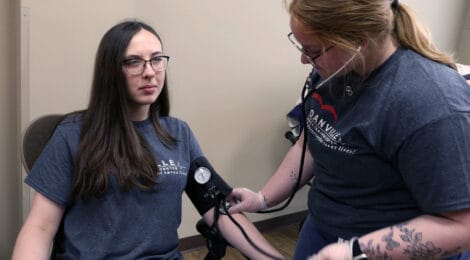

Virtually every industry is struggling to maintain a skilled workforce, and the emergency medical services (EMS) field is no exception.
With higher call volumes, increasing demand for services, and the persistent threat of burnout among EMS professionals, the need for innovative workforce strategies has become even more critical.
Two Southern Virginia EMS providers have recently created registered apprenticeship programs as a creative, win-win strategy to grow and maintain their workforces. These programs are appealing because they allow apprentices to earn fair wages during employer-sponsored on-the-job and classroom training.
Two cohorts totaling 18 employees are participating in the Danville Life Saving Crew’s EMT Registered Apprenticeship program – the first in the commonwealth of Virginia – which launched in October 2023 and takes a year to complete.
Franklin County Public Safety has five people enrolled in the first cohort of its Paramedic Registered Apprenticeship program, which launched in January 2024 and was created with several partners.
The Institute for Advanced Learning and Research (IALR), which supports the creation of registered apprenticeship programs across Southern Virginia through its Expanding Talent through Registered Apprenticeship (ExTRA) program, has helped both EMS organizations navigate the creation and implementation of a successful apprenticeship program. Staff are using this experience to work with and educate other localities and EMS providers across Southern Virginia.
“Construction and utilities sectors are commonly associated with apprenticeship. But there’s a wave of exciting opportunities in nontraditional sector apprenticeships, such as healthcare and emergency medical services, early childhood education and technology. Apprenticeship can absolutely be implemented in nontraditional sectors.” – Natori Neal, Apprenticeship Coordinator, IALR
State Registered Apprenticeship provides on-the-job training, related technical instruction (RTI) and a paid job as one cohesive experience, making them the “pinnacle” work-based learning opportunity. Registered apprenticeship is a high-quality, industry-driven workforce training strategy that combines on-the-job training and classroom instruction to develop highly skilled employees in a particular occupation.
Trainees receive pay increases as they acquire skills and training milestones, culminating in a nationally recognized journeyworker credential upon completion. This credential, along with practical experience, enables them to mentor future apprentices, ensuring a steady supply of skilled talent for businesses.
Apprenticeship programs mandate at least 2,000 hours of on-the-job training and 144 hours of classroom instruction, which can typically be completed within a year. However, some programs may require as much as 10,000 hours of on-the-job training, depending on the complexity of the occupation and the skills involved.
Employers can customize the related technical instruction according to their specific needs. They can choose the instruction provider or even deliver the instruction themselves, ensuring that the training aligns precisely with the skills and competencies required for the role.
From 2022 to the present, IALR’s ExTRA program has helped register 60 apprentices and 24 registered apprenticeship programs. Many more programs are in varying stages of development. Through ExTRA, as a state-approved and award-winning apprenticeship intermediary, IALR provides the following types of support to employers across the 15 localities in GO Virginia Region 3:
Historically, the Danville Life Saving Crew had few options for recruiting EMTs. They could hire people who already had their training from somewhere else, or people could pay for EMT courses on their own on a part-time or full-time basis.
The EMT Registered Apprenticeship program, an extension of a paid recruit academy framework that the Danville Life Saving Crew implemented earlier in 2023, allows them to hire and train those with no previous experience.
“With the apprenticeship program, we can select people who have the right mentality but don’t have the means to obtain the certification on their own. This allows us to bring that group together and create this class of people who wouldn’t be able to do this without the apprenticeship program.” – Johnny Mills, CEO of the Danville Life Saving Crew
The apprentices spend most of the first 10 weeks completing their RTI with the Danville Area Training Center, preparing for their EMT-Basic exam. After passing their exam, the apprentices will be certified EMT-Basics and continue on-the-job training with increased duties alongside a mentor. After their one-year term, these apprentices will receive their journeyworker credential.
The paid on-the-job training and front-loaded RTI have simplified the process of finding quality candidates.

“The participants know up front that they’ll get paid to be here and complete the training. That’s a big recruitment tool for people jumping into the EMS field.” – Brian Alderson, Director of the Danville Area Training Center
Lily Hensley, one of the eight apprentices in the second cohort, which launched in early March, had spent her career to date working in customer service. She had tried part-time classes while working full-time, but that format did not work for her.
“This paid on-the-job training is a great way for me to absorb this information and get more hands-on instruction. I’m glad to be able to come in all day and focus on this, get a better experience and more ride time. All while getting a paycheck.” – Lily Hensley, EMT Apprentice with the Danville Life Saving Crew

The Danville Life Saving Crew will open a third station on the east side of the City of Danville later this year, requiring additional staff.
“This apprenticeship program is helping make it easier for the City of Danville to staff the extra ambulances.” – Johnny Mills, CEO of the Danville Life Saving Crew
While the Danville Life Saving Crew uses an apprenticeship program to get more people in the door as EMTs, Franklin County Public Safety uses apprenticeship as an opportunity to upskill and recruit.
In the EMS world, EMT is the entry-level. Then there is Advanced EMT, and finally there is Paramedic.
And that has proven to be the most challenging position for Franklin County Public Safety to keep filled.
“We’re understaffed. We’re short at least one paramedic on every shift. In essence, that’s a truck down. Then if we have staff who are sick or taking vacation, we are scrambling to find people.” – Hamp Ingram, EMS Coordinator, Franklin County Public Safety
Franklin County Public Safety launched the Paramedic Apprenticeship program early in 2024 with the support of several partners.
“A primary reason we started the program is the hope that we could recruit EMS providers to join our organization and become advanced-level providers while working with us. It’s going to help all the way around.” – Hamp Ingram, EMS Coordinator, Franklin County Public Safety
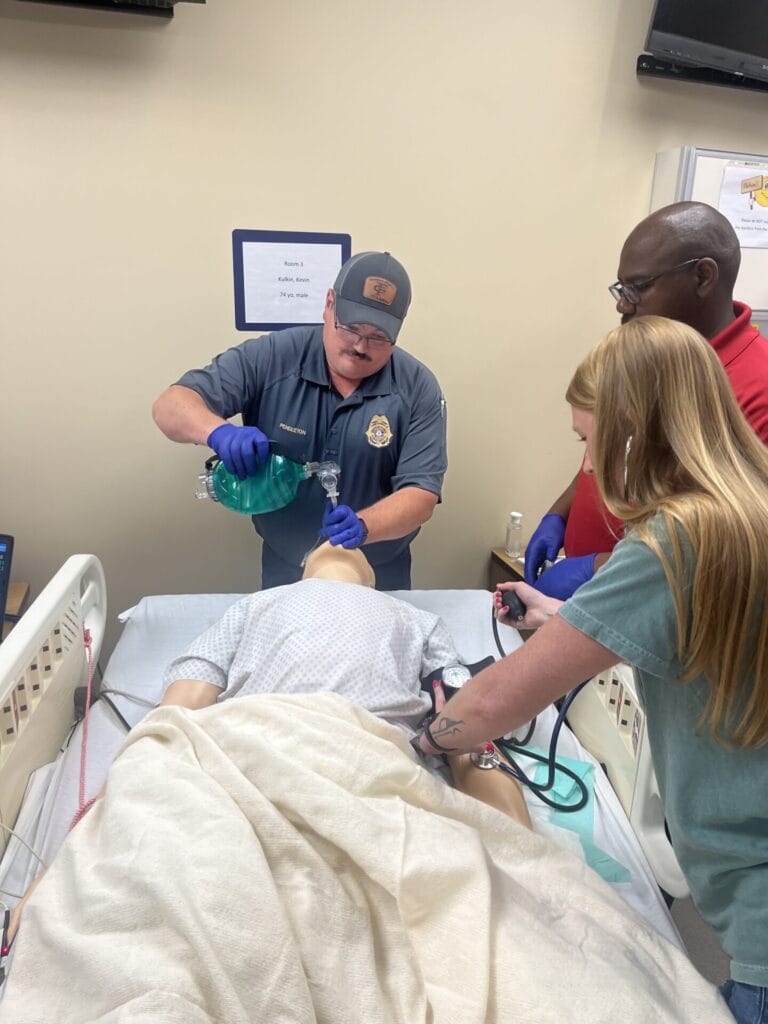
Most paramedic programs take about two years to complete; Franklin County Public Safety designed their course to take just fifteen months. Holding an EMT certification is a prerequisite to participating in the apprenticeship program, which includes paramedicine basics and advanced life support skills. These apprentices are largely completing their classroom, clinical and truck time simultaneously and will continue to add responsibility as they progress and gain more skills.
The first and current cohort has 10 participants. Five of these are registered as apprentices and work for Franklin County Public Safety; the others are participating in the instruction to become certified paramedics and work other places.
Andy Pendelton is a fire marshal with Franklin County Public Safety. With experience in law enforcement and EMS, Pendleton has held his EMT for about fifteen years in total. He was thrilled to hear about the paramedic apprenticeship program that would allow him to continue earning as he went.
“I want to be able to go to the next level and provide more care, and I wouldn’t have been able to get my paramedic without this program.” – Andy Pendleton, Fire Marshal and Paramedic Apprentice, Franklin County
Traditionally, apprenticeship programs have been synonymous with the construction and trades industries, where hands-on experience and specialized skills are critical. The combination of on-the-job training and classroom instruction is perfect for traditional fields such as carpentry, plumbing, electrical work and welding.
While IALR has supported organizations in those sectors, the ExTRA program is helping Southern Virginia employers navigate the creation of programs in non-traditional sectors like EMS. Other apprenticeship programs in the works include digital marketing, UX design and early childhood education. Based on the success of the Franklin County and Danville Life Saving Crew programs, other EMS agencies are exploring apprenticeship options with Natori Neal.
“We helped Danville Life Saving Crew and Franklin County Public Safety through the entire registration process, and we are ready to help other employers, no matter what sector they’re in, create effective apprenticeship programs.” – Natori Neal, Apprenticeship Coordinator at IALR


The Danville Pittsylvania County Chamber of Commerce, the Martinsville Henry County Chamber of Commerce, and the Institute for Advanced Learning and Research (IALR) are partnering to provide Chamber members an opportunity to learn about the Virginia Talent + Opportunity Partnership (V-TOP) and EmPOWER work-based learning framework. Both initiatives are designed to assist employers in recruiting talent and strengthening regional talent pipelines. V-TOP is funded through the Commonwealth Innovative Internship Fund and Program. The purpose of the program is to expand paid and credit-bearing student internships and other work-based learning opportunities in collaboration with Virginia employers and facilitate the readiness of students, employers, and institutions of higher education to participate in internship and work-based learning.
“This webinar is a direct result from requests of Chamber members in our annual membership survey,” said Anne Moore-Sparks, president and CEO of the Danville Pittsylvania County Chamber of Commerce. “Listening to the needs of business and responding with high quality, in-demand programming is a top priority. We are excited to partner with the Martinsville Henry County Chamber of Commerce and are fortunate to have IALR as a partner because of their experience and reputation in facilitating work-based learning opportunities.”
 |
 |
 |
There are several resources available through V-TOP to support businesses’ internship and work-based learning efforts, including modules to assist employers with developing an internship program, free mentor training, staffing agency services and internship stipend matching funds (for employers of certain sizes).
“Many of our chamber members are looking for ways to bring awareness to the talent pipeline. Our members are willing to utilize work-based learning opportunities as a valuable tool for introducing the workforce to their organizations,” said Brenell Thomas, president of the Martinsville Henry County Chamber of Commerce. “Partnering on this event made sense because it provides an efficient and convenient way for the members of both chambers to gain insight about the valuable resources available through V-TOP.”
The Institute for Advanced Learning and Research is the regional V-TOP facilitator for the Danville Pittsylvania County (and greater GO Virginia Region 3) region. EmPOWER is IALR’s employer-driven system to empower and connect students to careers and provides employers with a variety of opportunities and formats to connect with their future talent.
“Work-based learning is an amazing way to connect with young talent and develop employees with the skills employers need. Work-based learning is incredibly diverse — it’s not just internships. IALR’s EmPOWER team is passionate about connecting employers to programs and resources that work for their organization.” – Jessie Vernon, Program Manager for the Institute for Advanced Learning and Research
The one-hour webinar will be facilitated by both Jessie Vernon, Advanced Learning Program Manager, and Kiana Dillard, Work-Based Learning Coordinator, at the Institute for Advanced Learning and Research. While this webinar is designed for Chamber members only, non-Chamber businesses who are interested in additional information should contact Jessie Vernon at Jessie.Vernon@ialr.org or 434.766.6722.
There is no cost to attend but registration is required.
The Danville Pittsylvania County Chamber of Commerce accelerates business growth by connecting its 560+ member organizations and 22,000 employee members to dynamic resources and networks. The Chamber’s number one goal is to help area businesses of all sizes to grow and prosper.
The Martinsville Henry County Chamber of Commerce is a membership organization comprised of businesses serving our community. With over 600 members, the Chamber acts as a voice for businesses in the region while also providing opportunities for networking, collaboration, and increased community exposure.
The Institute for Advanced Learning and Research serves Virginia as a regional catalyst for economic transformation through applied research, advanced learning, manufacturing advancement, conference center services and economic development efforts. IALR’s major footprint focuses within Southern Virginia, including the counties of Patrick, Henry, Franklin, Pittsylvania, Halifax, and Mecklenburg along with the cities of Danville and Martinsville.
A wave of 20 seventh graders at Gretna Middle School floods through the classroom doors right as the clock strikes 12:45. They take their seats at the computers around the classroom’s edge.
But this isn’t a traditional classroom.
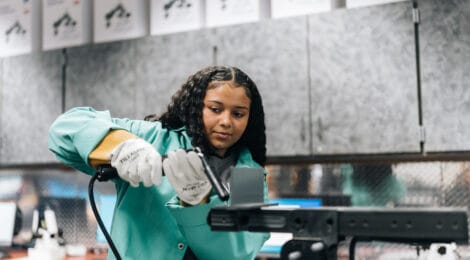
In the middle of the room is a virtual reality welding simulator. Connected to each computer is a small robot that sorts blocks based on color. Near the door are several 3D printers and a laser scanner.
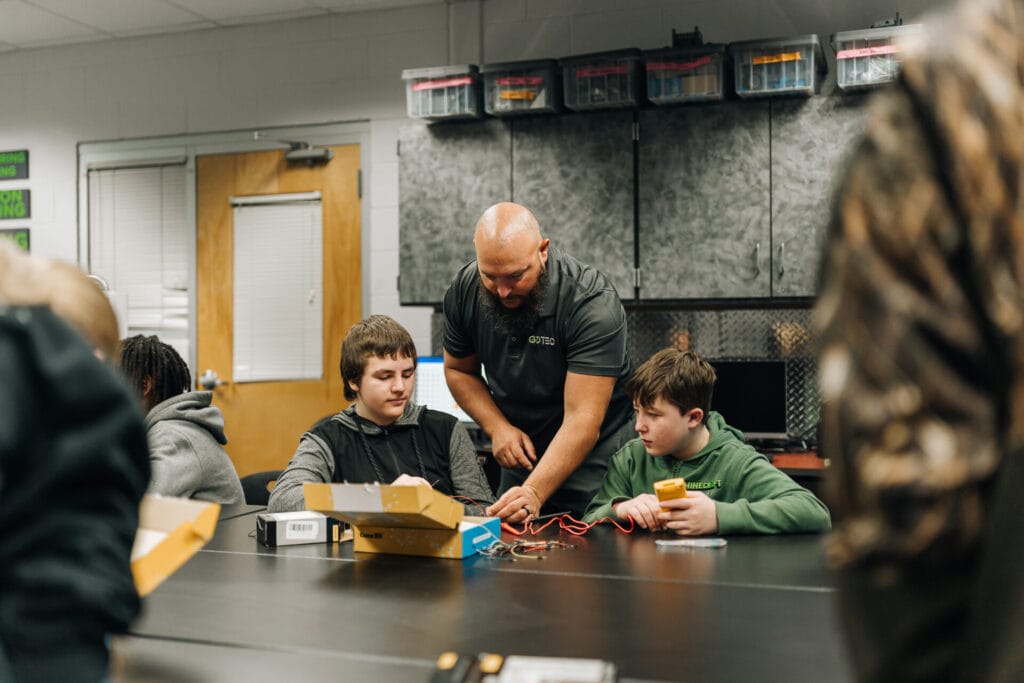
The teacher, Christy Shelton, calls each student to sit at the large center table and prepare for the day’s activity – the culmination of a weeks-long unit about electrical engineering. A palpable, chaotic energy permeates the room as Shelton tries to quiet the class and explain the assignment: creating a small flashlight utilizing a mini-LED light and a homemade circuit.
“Electrical circuits should be fun,” Shelton says in between rapid-fire instructions to the class.

Students participate in an electrical engineering project in a GO TEC Career Connections course at Gretna Middle School.
Each day, Shelton teaches approximately 100 students in this Great Opportunities in Technology and Engineering Careers (GO TEC® ) course, leading students in hands-on activities like engineering a flashlight and exposing them to STEM-focused career opportunities.
“My favorite parts were the electrical engineering and mechanical engineering,” says Caleb Dowell, a seventh grader in the GO TEC Career Connections class. He says the lessons are fast-paced, but they are engaging and inspire him to think about his future work.
“I’m still thinking about it,” he says about his future career plans.
The GO TEC program provides middle school students with innovative, hands-on exposure to careers in strategic sectors – and helps them identify the steps needed to pursue those careers. After starting as a pilot program that began in Danville and Pittsylvania County Schools, 9,000+ students from 44 different middle schools will interact with the GO TEC curriculum annually starting in the 2024-2025 school year. The Institute for Advanced Learning and Research (IALR) serves as the fiscal agent and program lead for GO TEC, which both provides applied STEM education and connects students to careers.
“There’s a lag time for education to respond to emerging technologies and industries. The GO TEC program focuses on shortening the lag time by introducing middle schoolers to these growing career opportunities and innovative technologies that are already taking root. This is an economic development initiative as much as it is a workforce development opportunity, and GO TEC helps set Virginia apart as a work-ready state with highly-skilled talent.” — Dr. Julie Brown, Vice President of Advanced Learning, IALR
The primary goal of the GO TEC program is to let students experience in-demand and growing manufacturing and engineering career fields with applied learning.
Many of the industry pathways covered in the program, such as welding and automation, require critical skills needed across various industries. Other modules, like controlled environment agriculture, are focused on a specific industry and combine various skills from other modules.
The Level 1 GO TEC experience is typically broken into a nine-week course with at least one module each week. Some of the modules, such as controlled environment agriculture, actually extend across multiple weeks and other modules.
| Electrical Engineering | Automation and Robotics | Additive Manufacturing (3D Printing) |
| Mechanical Engineering | Welding | IT Coding and Networking |
| Manufacturing Engineering | Precision Machining | Metrology |
“They especially love the 3D printing, laser cutting and robotics, but you’ll get a few ‘aha’ moments with pretty much every module. I have the best job in education.” — Christy Shelton, GO TEC Career Connections Teacher, Gretna Middle School
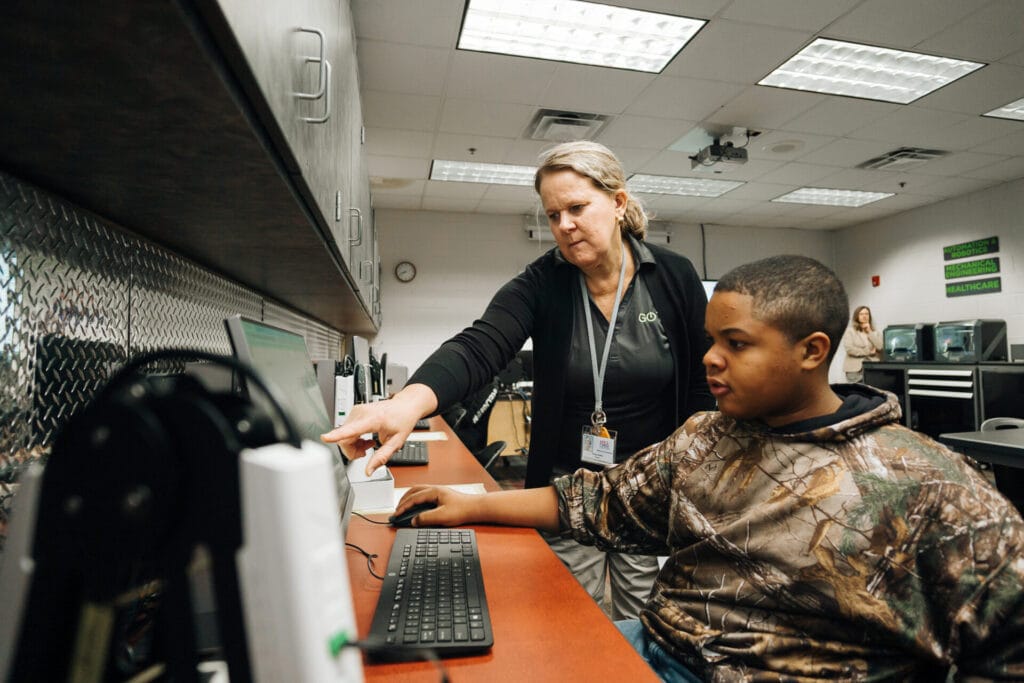
Christy Shelton, GO TEC Career Connections Teacher at Gretna Middle School, says students have a few “aha moments” with almost every module.
Currently, 19 school divisions provide the GO TEC Career Connections curriculum to their middle school students. Some divisions offer GO TEC as an elective course that students can choose to take; others require that every student complete the curriculum at some point during middle school. Some divisions even have the capacity for students to have sequential experiences across multiple grade levels. It all depends on the size of the individual school and the division as a whole.
“We would love for 100% of students in our partnering divisions to have at least the level one exposure.” — Dr. Julie Brown, Vice President of Advanced Learning, IALR
Cumberland County Public Schools, one of the first school divisions to adopt the GO TEC program, requires every middle school student to participate in the GO TEC Career Connections program. A big part of the appeal for the school division was the “career exploration piece,” said Superintendent Dr. Chip Jones.
“They’re eager to go to class, they’re eager to learn, and they’re eager to learn about how they can build different things. They can see the application of what they’re learning in other classes. They’ll learn about angles in math class, and then in GO TEC they’ll see why it’s important to understand that concept.” — Dr. Chip Jones, Superintendent, Cumberland County Public Schools
Decades ago, it was common for middle schools to have industrial arts courses where students participated in applied learning with tools like drill presses and grinders. Those industrial arts programs became less common, and computers became the technology of choice as prices dropped and the Internet emerged. At the same time, society and parents guided more and more students towards four-year degrees.
“While having access to computers in the classroom is critical, we realize that we need to integrate other relevant and emerging technologies back into the classroom – less screen time and more hands-on, active learning.” — Jacob Taylor, Technical and Training Manager, GO TEC
While the most innovative element of the GO TEC program is the middle school labs, the multi-region effort is about more than just technology integration. Through partnerships with K12 school systems, higher education and industry, GO TEC is a collaborative talent pathway model that begins in the middle school Career Connections Labs and continues through high school, dual enrollment and postsecondary programs.
“Giving middle school students a hands-on, memorable introduction to skilled trades at such a formative time in their lives increases the likelihood that they will pursue those careers later.” – Ben Davenport, IALR Board of Trustees, State Board for GO Virginia
The GO TEC Career Connections program curriculum is both flexible and scalable. School divisions can choose which modules make sense for their particular area based on regional employers or economic development goals. Each module’s equipment and content is standardized, ensuring that students across the Commonwealth receive the best instruction.
IALR staff also operate a GO TEC bus, equipped with all the same equipment as the middle school labs. This mobile GO TEC Career Connections lab can be utilized for training or for student experiences.
Industry trends and needs guide both the subject and content of the modules. As the program has scaled, the GO TEC team has the expertise and infrastructure to rapidly develop new, industry-driven modules – like the CEA module that went from an idea to the classroom in just eight months.
“My goal is not just that great career opportunities are available in Southern Virginia, but also that my constituents have knowledge of those opportunities and access to whatever training, skills and education are necessary to obtain them. Through engaging, active experiences, the GO TEC program brings that awareness and guides students on the path of how to reach those careers.” — Frank Ruff, Virginia State Senator for District 15, State Board for GO Virginia
“GO TEC will stimulate job growth within the Commonwealth by creating dependable talent pipelines in strategic sectors, fostered through public and private partnerships.”
That’s GO TEC’s mission statement, which underscores the fact that the program, at its core, is about economic development, job growth and preparing students for quality local employment opportunities.
But, the program is also an effective recruiting tool for new companies.
Linda Green is the Vice President of Economic Development for IALR and the Executive Director for the Southern Virginia Regional Alliance (SVRA). In a very general sense, Green’s job is to sell Southern Virginia to companies, convincing them that this is the best place for their company to establish a new operation or expand. Every company asks similar questions: “Where will the workers come from, and will they have the skills and background to meet our needs?”
To help answer that question, Green and other regional economic developers show the GO TEC program to every prospective company. Sometimes, they visit the GO TEC Training Lab at IALR; in many cases, however, they go to one of the middle schools, allowing prospects to speak with students and see the program in action.
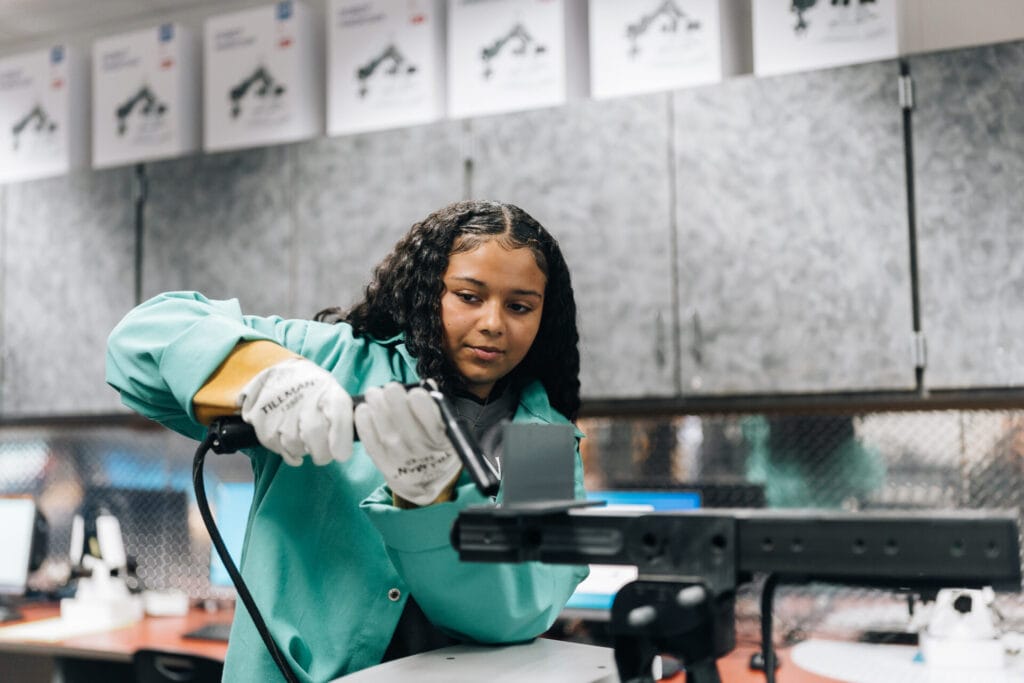
A student at Gretna Middle School uses a welding simulator as part of the GO TEC Career Connections course. The program introduces students to strategic career sectors through applied learning.
“Businesses see the GO TEC classes and recognize the program’s value to inspire middle students as a source for their future workforce. The effectiveness of the GO TEC program – and how it funnels directly into a variety of other strong, proven workforce training programs – is a primary selling point for Southern Virginia.” — Linda Green, Vice President of Economic Development, IALR; Executive Director, SVRA
The recent investments in the Southern Virginia region by various companies can be attributed to the presence of a strong and well-trained workforce. For example, Tyson Foods recently opened a fully cooked food production facility worth $300 million in the area. The company’s news release highlighted that this plant is one of their most advanced and automated ones, showcasing their commitment to incorporating innovative technologies. Tyson’s leadership expressed confidence in the region primarily because of the seamless pipeline of workforce programs available. This pipeline begins with GO TEC and extends to other regional programs. The availability of skilled workers reassured Tyson that they could implement more automation in their facility, which would result in a slight reduction in job numbers but an increase in overall quality and efficiency.
“GO TEC has influenced companies that have chosen to invest in Southern Virginia in the past few years,” Green says. “As the program expands to other regions, I am confident that the addition of GO TEC to their workforce pipeline will help other regions of the Commonwealth recruit new employers.”
And the program is already impacting other areas of the Commonwealth.
“Tomorrow’s successful companies depend on talent development done today, and GO TEC is an incredible way to inspire the next generation of engineers and innovators. Hampton Roads companies like Huntington Ingalls have played a vital role in this important program’s success and are helping Virginia maintain its position as a top state for talent.” — Douglas L. Smith, President & CEO, Hampton Roads Alliance
The GO TEC program is still young. The first cohort of students who experienced multiple years of the Career Connections Labs are just juniors in high school today. GO TEC staff are looking at preliminary data to determine what tracking measurements are needed, determining if students are entering Career and Technical Education (CTE) pathways or what else is beyond high school for them.
“We know how to support it, we know how to scale it, but in some ways, we are building it as we fly, learning how young people make future education and career decisions.” — Dr. Julie Brown, Vice President of Advanced Learning, IALR
In five years and during a pandemic, the program has effectively spread across the Commonwealth, serving students in 25 middle schools during the 2023-2024 school year. GO TEC 2025 is the plan to expand the Career Connection Labs and curriculum in 50 schools by 2025.
| GO TEC will serve 44 middle schools across 36 Virginia localities | 9000+ students will complete the GO TEC curriculum annually | The program leverages $20 million in total public and private investment |
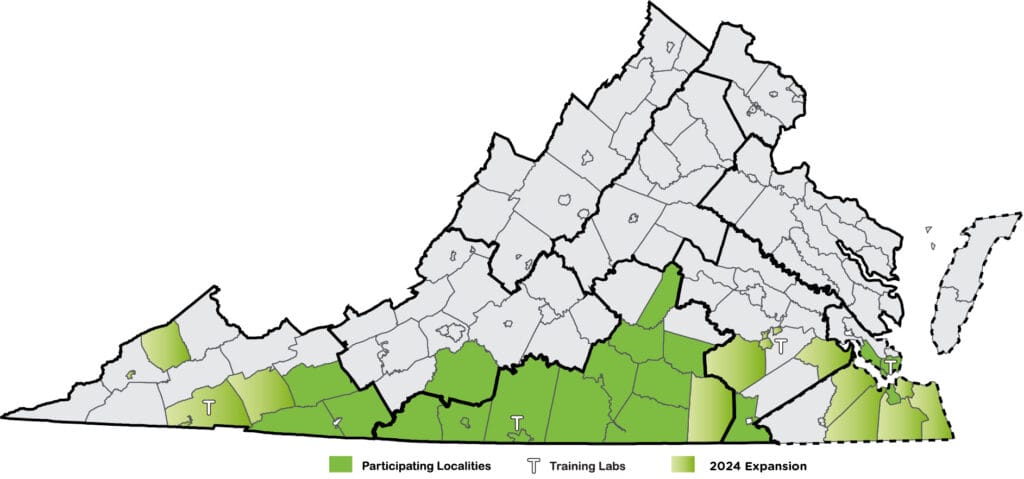
The program leverages $9 million in total funding from GO Virginia, along with another $11 million from localities, federal agencies and philanthropy. A $3.4 million grant from GO Virginia is driving GO TEC 2025.
“Exposing middle schoolers to the diverse career options available to them in their community – as well as the jobs that will become available in the future – is a strategic approach that is worth the financial investment.” – Frank Ruff, Virginia State Senator for District 15, State Board for GO Virginia
To allow this growth, the GO TEC team is expanding to include program coordinators and training coordinators in four different regions of Virginia, as well as three positions (program director, technical and training manager, and program assistant) based out of IALR. Six of these positions will come on board with IALR in early 2024.
IALR, the GO TEC lead agency and coordinator in GO Virginia Region 3, is also working with three In-Region Coordinating Entities (IRCEs), each of whom are housing training labs and partnering with IALR to drive the program’s expansion in different regions. (IALR also has a training lab for teachers in GO Virginia Region 3.)
“A longtime partner of IALR, we have worked for years to bring new public-private partnerships to Southwest Virginia focused on developing the talent pipeline of the workforce of tomorrow. With the alignment of the growth sectors projected for our region and the GO TEC focus areas, we raised our hand to coordinate the GO TEC expansion to continue the work all toward our workforce of tomorrow. Undoubtedly, GO TEC will positively impact our region of Southwest Virginia.” – Mary Anne Holbrook, Vice President of Community Impact, United Way of Southwest Virginia
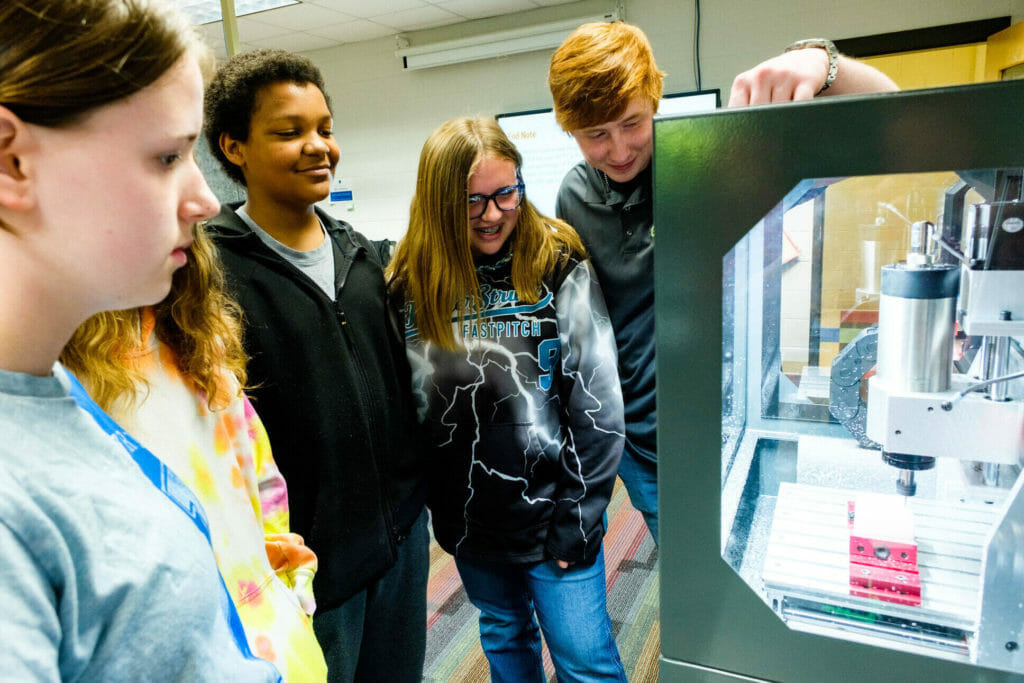
The strength of GO TEC is in the collaboration between industry, academia and K12, but the program is only possible because of widespread public and private sector support. For instance, localities and school divisions invest in the equipment needed to outfit the labs at each school and provide the space and classroom teachers.
“As the GO TEC curriculum reaches more students across different regions of Virginia, the program’s impact will only become more measurable and profound. I am confident that current and future investments from IALR, GO Virginia and other partners will continue to reshape and improve career exploration opportunities for Virginia students.” – Ben Davenport, IALR Board of Trustees, State Board for GO Virginia

“GO Virginia Region 3 and IALR are well poised to be the leader in the Commonwealth for Controlled Environment Agriculture.” — Elli Travis, Senior Economic Development Specialist, Virginia Tech Center for Economic and Community Engagement
This episode of “Inside IALR” features a roundtable conversation with several leaders involved in the recent creation of a controlled environment agriculture (CEA) Roadmap Strategy for GO Virginia Region 3:
They discuss the current state of the CEA industry as a whole, but specifically in GO Virginia Region 3. While discussing the roadmap, they explain how CEA represents tremendous economic opportunity and growth potential for Virginia.
Some of the directives outlined in the CEA roadmap include establishing a CEA hub that will focus on awareness and informational campaigns, new venture and new enterprise development assistance, expanding CEA technical assistance, accelerating Region 3 site development and continuing and enhancing CEA-relevant workforce development and talent.
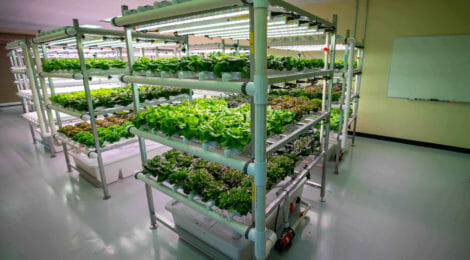
Several partner organizations recently completed the development of a strategic roadmap regarding the economic growth potential for the Controlled Environment Agriculture (CEA) industry in the Commonwealth of Virginia, specifically in the 15 localities within GO Virginia Region 3. Analyzing the current state of the industry, this roadmap outlines ways that the partners can support future economic growth among large and small companies in the CEA sector through a variety of initiatives tied to collaboration, research, economic development, workforce training and more.
The development of this roadmap, which was completed by the Virginia Tech Center for Economic and Community Engagement (CECE) in partnership with IALR, was funded through a $77,000 grant from GO Virginia Region 3.
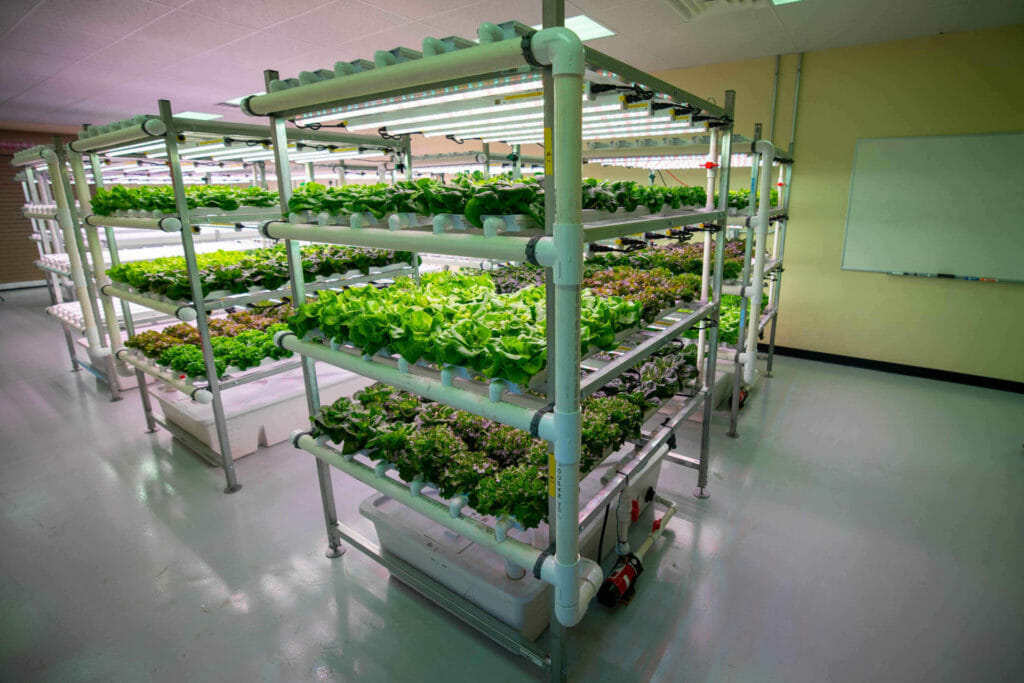
“While controlled environment agriculture is not a new industry, it is growing quickly and has major economic implications for our region. Intentional partnerships and public-private collaboration are what will allow this important sector to thrive and expand right here in Southern Virginia and across the Commonwealth. Building on the current strength of the region, this roadmap outlines several crucial steps we can take to advance the CEA industry.” — Dr. Scott Lowman, Vice President of Applied Research, IALR
CEA involves a combination of engineering, plant and animal science, and computer-managed control technologies used to optimize plant and animal growing systems, quality and production efficiency. Growing systems range from a basic greenhouse to a fully automated system with controlled lighting, water and ventilation installed. By controlling various elements of the growing environment, CEA can decrease pesticide and water use and allow for year-round production close to consumers. The concept of CEA is not new, but more recent technological advancements like biotechnology, robotic imaging and machine learning have changed the economics of CEA as an industry.
The primary recommendation of the roadmap is the development and implementation of a comprehensive CEA hub initiative, in conjunction with or led by IALR and the Virginia Tech-IALR CEA Innovation Center. This hub would lead and advance five additional strategies in GO Virginia Region 3 and across the state:
“We were excited to find that continued growth is expected in the CEA industry. GO Virginia Region 3 is well-positioned to remain competitive as a location for this growth. In addition, the CEA Hub Initiative would help the region, and the state, to better maximize this opportunity and grow CEA sector jobs of all types, from smaller start-ups to large-scale indoor farming.” — Dr. Scott Tate, Associate Director for Community Innovations, Virginia Tech Center for Economic and Community Engagement
Due to the technology used in CEA, the skillsets required tend to be more varied than traditional farming and typically appeal to a younger workforce. Although much of CEA is automated, skilled workers are still invaluable for guiding and overseeing the equipment, plant and animal health, and other hands-on work. Some common occupational areas within CEA companies include crop production, animal production and aquaculture, machinery manufacturing and computer and electronic product manufacturing.
Virginia Secretary of Agriculture and Forestry Matthew Lohr recently shared remarks during the presentation of this roadmap at IALR.
“When an organization lacks vision, it is much harder to reach the destination. This roadmap outlines how Southern Virginia can become a hub for the CEA industry and the steps needed to get there. The synergies outlined in this plan, including workforce training, research, increased awareness and site development will make Southern Virginia a CEA leader.” — The Honorable Matthew Lohr, Virginia Secretary of Agriculture and Forestry
The partners involved in the study identified a total of 18 CEA companies operating or preparing to open in Virginia, seven of which are larger operators that have 50 or more employees. In all as of 2022, the team estimates there are approximately 35,000 existing CEA-related jobs in the state, 1,750 of which are in GO Virginia Region 3. Virginia has seen an increase in CEA companies locating in the state, with announcements of major projects like Plenty in Chesterfield County in 2022, expected to bring 300 new jobs and $300 million in investment to the area. Blue Ridge Aquaculture, a Martinsville-based company that is the largest indoor system producer of tilapia in the world, and AeroFarms, a leading vertical agriculture company that established one of the world’s largest aeroponic smart farms in Danville-Pittsylvania County’s Cane Creek Centre, are the largest existing CEA companies in GO Virginia Region 3.
“One of the primary goals of economic development is increasing household income, which typically leads a region’s residents to experience increased educational attainment, improved health outcomes, housing values, and household discretionary income. While large CEA companies can provide quality and high-wage employment opportunities in GO Virginia Region 3, another critical focus of this strategy is to promote and facilitate CEA-related entrepreneurship and small business opportunities, combining macro and micro approaches to grow this emerging business sector in Southern Virginia.” — Bryan David, GO Virginia Region 3 Program Director
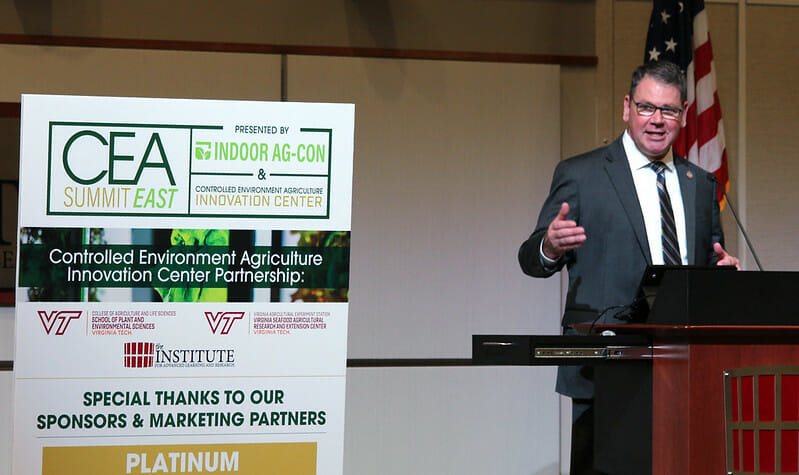
The study identifies the Virginia Tech-IALR CEA Innovation Center, located on IALR’s campus, as a “unique and crucial asset and resource for innovators, policymakers and industry in the CEA sector.” This facility, which is operated through a partnership with IALR, the School of Plant and Environmental Sciences at Virginia Tech and the Virginia Seafood Agricultural Research and Extension Center, leverages the biotechnology and chemistry research at IALR and serves as a demonstration site and agricultural technology training center that brings together industry, academia and producers.
The CEA Innovation Center also serves as a co-host of the annual CEA Summit East.
“The outstanding work conducted by the whole team in developing the CEA Roadmap will help all of us to effectively work together in our common goal of making Virginia an international hub for controlled environment agriculture and utilizing the growing field of controlled environment agriculture as an economic development engine for Virginia. We are looking forward to exciting collaborations going forward.” — Dr. Michael Evans, Director of the School of Plant and Environmental Sciences, Co-Director of the CEA Innovation Center
GO Virginia is a statewide, business-led economic development initiative with funding to invest in collaborative projects that lead to high-paying jobs in each region. The mission of GO Virginia is to encourage collaboration among business, education and government in each region. GO Virginia Region 3 is one of nine regions in Virginia and includes the counties of Amelia, Brunswick, Buckingham, Charlotte, Cumberland, Halifax, Henry, Lunenburg, Mecklenburg, Nottoway, Patrick, Pittsylvania and Prince Edward and the cities of Danville and Martinsville. For more information, please visit govirginia3.org and sign up for the Region 3 monthly newsletter or connect with GO Virginia Region 3 on Facebook or LinkedIn.
The Institute for Advanced Learning and Research serves Virginia as a regional catalyst for economic transformation with applied research, advanced learning, advanced manufacturing, conference center services and economic development efforts. IALR’s major footprint focuses within Southern Virginia, including the counties of Patrick, Henry, Franklin, Pittsylvania, Halifax and Mecklenburg along with the cities of Martinsville and Danville. For more information, visit www.ialr.org.
The Center (formerly known as the Office of Economic Development) connects Virginia Tech faculty, companies, and communities in ways that help create, retain, and enhance the availability and quality of jobs and opportunities around the Commonwealth. This includes providing applied research, technical assistance, and training services to increase clients’ abilities to prudently manage economic change and build capacity to stimulate change.
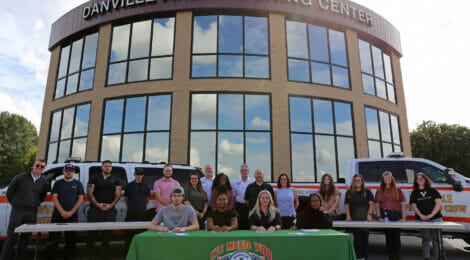
In partnership with the Institute for Advanced Learning and Research, the Danville Life Saving Crew – the primary Emergency Medical Services provider for the City of Danville – signed 13 individuals as Virginia’s first Emergency Medical Technician (EMT) registered apprentices during a ceremony on Oct 6. Over the next several months, these 13 apprentices will be fully employed with the Danville Life Saving Crew while they study and practice in a classroom environment in preparation to obtain their Emergency Medical Technician Certification from the National Registry of Emergency Medical Technicians. In addition to the National Registry certification, each person completing the program will obtain their Journeyworker Credential from the State Apprenticeship Agency. The EMT apprenticeship program is one year, which equates to 2,000 hours of on-the-job training.
“IALR is proud to work with the Danville Life Saving Crew to facilitate the development and launch of the first Registered EMT Apprenticeship program in the Commonwealth of Virginia. In a time when emergency service providers around the country are struggling to hire and retain qualified personnel, this apprenticeship program will increase the number of trained and qualified EMTs for the Danville Life Saving Crew. This innovative program represents a milestone in IALR’s goal to expand talent through registered apprenticeship and demonstrates how apprenticeships can be used to develop skilled workers in non-traditional sectors.” — Natori Neal, Apprenticeship Coordinator for IALR, a Virginia Division of Registered Apprenticeship Intermediary and program sponsor
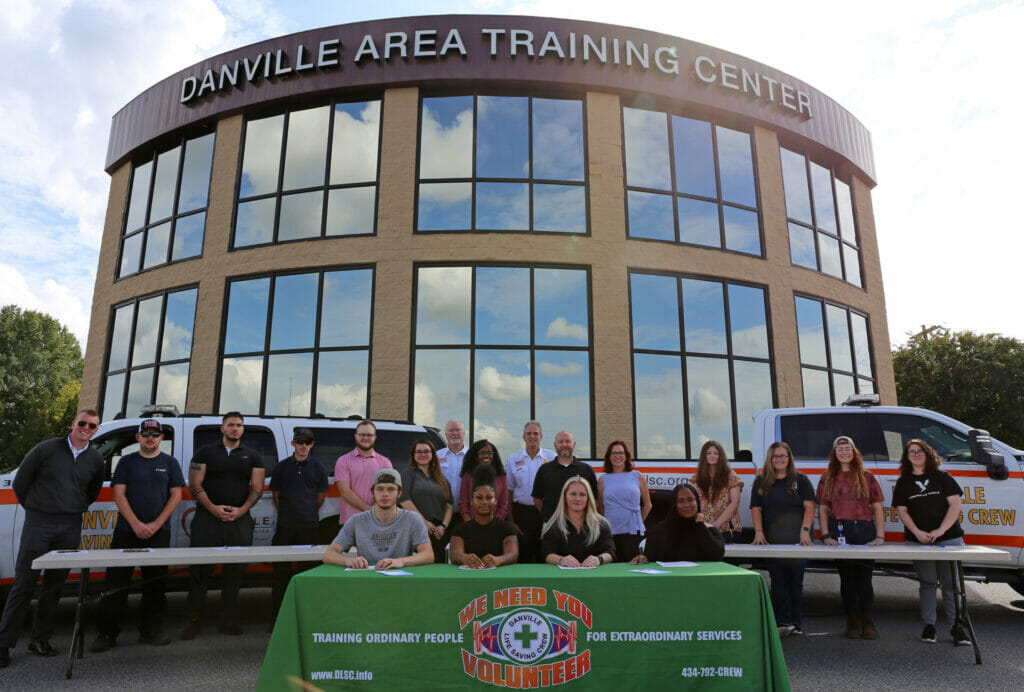 During an Oct. 6 ceremony, the Danville Life Saving Crew signed 13 registered EMT apprentices. |
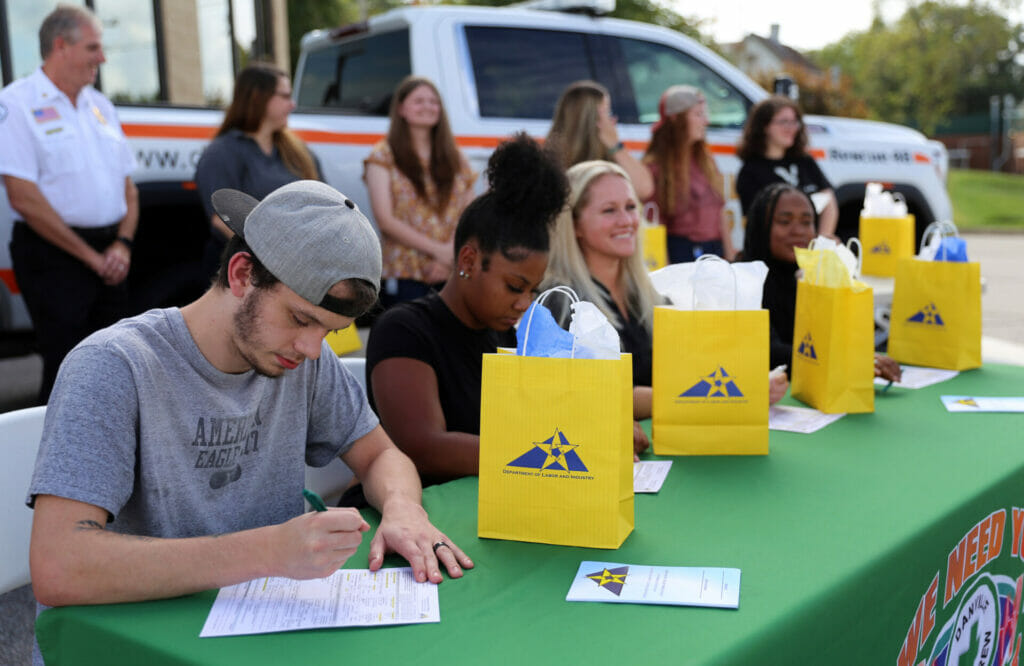 Created in partnership with IALR, this is the first registered EMT apprenticeship program in Virginia. |
“This EMT apprenticeship program will benefit the participants by providing mandatory training for an EMT position. Adding a cohort of new EMTs like this enables the Danville Life Saving Crew to grow its team and provide qualified emergency medical personnel for our community. “The Crew piloted this program in 2022 before beginning the process to become registered apprenticeship program sponsors. Working with Tori and the Institute has been easy and successful, and we are very pleased that our program is the first registered EMT apprenticeship program in Virginia.” — Johnny Mills, CEO of the Danville Life Saving Crew
Virginia registered apprenticeship programs require a mix of on-the-job training and related technical instruction (RTI). For this program, the RTI will be front-loaded into the first 10 weeks and provided by the Danville Area Training Center. After completing classwork and waiting for their EMT exam date, the apprentices will work as a third person on an Emergency Response Vehicle. After passing their exam, the apprentices will be certified EMT-Basics and can continue on-the-job training with increased duties alongside a mentor. The apprentices will respond to emergency calls, provide basic life support/pre-hospital services to the critically ill and injured, and transport patients to a medical facility, always working in collaboration with and under the direction of other crew members and the incident command.
The Virginia Department of Labor and Industry (DOLI) Division of Registered Apprenticeship approved the Danville Area Training Center as a private RTI provider earlier this year. The apprenticeship program was officially registered with DOLI in April.

After their one-year term, these apprentices will receive their Journeyworker Credential, a portable, nationally recognized credential from the State Apprenticeship Agency that demonstrates mastery of skills and competencies. In addition to the EMT and Journeymen certificates, participants will also earn CPR and Emergency Vehicle Operator Course (EVOC) certifications. After obtaining these certifications, these individuals can then serve as mentors for future EMT apprentices.
Registered apprenticeship is an occupation-specific training model designed to produce highly skilled workers to meet the demands of employers. The model includes a paid job experience for employees that includes a combination of on-the-job training and related technical instruction.
“The Division of Registered Apprenticeship is proud to partner with IALR to increase the reach of registered apprenticeships as a training and career pathway. The registered apprenticeship program with Danville Life Saving Crew demonstrates new ways to utilize the RA model to increase needed emergency credentials. This opportunity to ‘earn while you learn’ will broaden the pool of trained emergency personnel for the Danville area, illustrating why registered apprenticeship is a win for everyone from the DLSC to the citizens whom they will serve.” — Kara Joyce, Registered Apprenticeship Consultant with the Virginia Department of Labor and Industry
Through the Expanding Talent through Registered Apprenticeships (ExTRA) program, IALR has helped establish 18 apprenticeship programs with various companies across Southern Virginia in industries like construction, healthcare and manufacturing. Some of these companies have already hired apprentices to complete those programs, whereas others are working through logistics before beginning to hire apprentices. IALR’s efforts to expand registered apprenticeship programs in Southern Virginia are supported by grants from the Virginia Tobacco Region Revitalization Commission. These grants fund both IALR’s Apprenticeship Coordinator — Natori Neal, who began work in February 2022 — and reimburse eligible RTI costs for employers establishing new registered apprenticeship programs.
IALR’s apprenticeship program is part of the EmPOWER framework, an employer-driven, work-based learning system of programs that systematically connects students to careers through focus areas like career awareness, career exposure and engagement opportunities, and career experience through apprenticeships, internships and other work-based learning programs.
“Working with partners to connect students to careers and prepare Southern Virginia residents for career opportunities is a major focus of IALR. The new, unique Registered EMT Apprenticeship program exemplifies our commitment to workforce development that meets the needs of both the trainees and the employers in the region.” — Jessie Vernon, IALR Advanced Learning Program Manager
The Virginia Career Works West Piedmont Region is partnering to provide supportive services for apprentices in the program, including 50% wage reimbursement to DLSC for 10 weeks. They will also provide monetary incentives to apprentices for reaching certain milestones during the program.
The Danville Area Training Center was established and dedicated in 2003 to provide a regional training facility to the city of Danville and nearby agencies. Today, the Danville Area Training Center (DATC) educates thousands of healthcare providers, EMTs, and community members annually. The DATC offers courses in First Aid and CPR, Basic and Advanced Life Support, Pediatric Advanced Life Support, Emergency Medical Technician, Vehicle Rescue Awareness and Operations, Emergency Vehicle Operations, Mass Casualty and Traffic Incident Management.
Serving the City of Danville and portions of the surrounding counties, the Danville Life Saving Crew employs volunteers and career staff to provide prehospital care. First founded in 1945, the Danville Life Saving Crew’s mission is to be the leader in delivering prehospital care to the sick and injured. It is also their goal to provide superior training to our members and members of other agencies throughout the community.
The Institute for Advanced Learning and Research serves Virginia as a regional catalyst for economic transformation with applied research, advanced learning, advanced manufacturing, conference center services and economic development efforts. IALR’s primary service area is Southern Virginia, including the counties of Patrick, Henry, Franklin, Pittsylvania, Halifax and Mecklenburg along with the cities of Martinsville and Danville.
“When will I ever use this in the real world?”
A Math and Algebra 1 Teacher at Fieldale-Collinsville Middle School, Brittany Price, hears that question from her students almost daily.
“They want to know how the content they are learning in class will help them in their chosen career field one day,” she said. “These are valid questions that were difficult for me to answer.”
After participating in the Exploring Careers through Industry Teacher Externships (EXCITE) program earlier this summer, Price is better equipped to answer those questions and connect math concepts to regional employment opportunities. In just a week, Price spent time in Press Glass in Ridgeway, Henry County Public Safety, the Animal Medical Center in Danville and Danville Utilities.
“After participating in EXCITE, I can see how the math we teach students can be applied in different industry scenarios.” — Brittany Price, Algebra Teacher, Fieldale-Collinsville Middle School
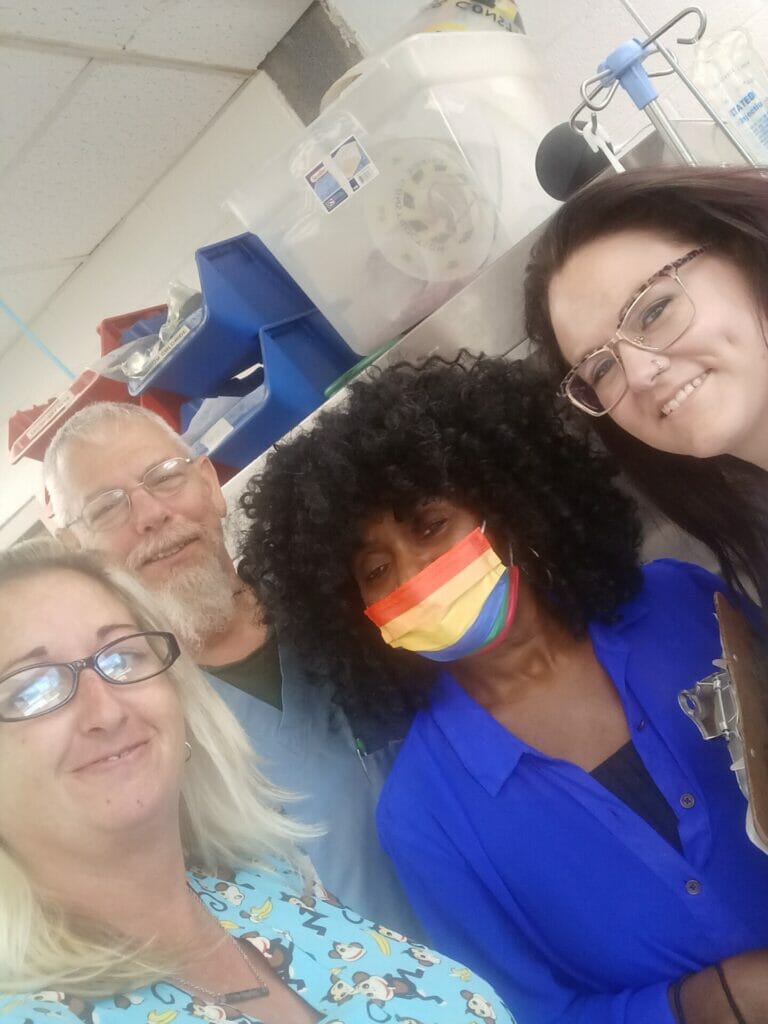
Brittany Price (right) was one of 21 Southern Virginia educators who participated in the week-long EXCITE program this summer. During this externship program, these educators visited local industries, learning about opportunities in the region and making connections to the classroom.
This year 21 Southern Virginia educators participated in the week-long EXCITE program, connecting with local industries and employers and making connections to their classrooms. Two cohorts of educators visited various employers, including government organizations, manufacturers, sawmills, HVAC companies, utility providers and many other industries.
“I can share my experience at these businesses with my students and let them know what job opportunities are available and what skills they will need to succeed.” – Wayne Talley, Carpentry Teacher at Mecklenburg County High School.
First developed in 2018 and funded by the Danville Regional Foundation and organized by IALR, the professional development program is now available for educators across GO Virginia Region 3.
The main goal is simple: to connect the classroom to the workplace by engaging teachers and counselors with business and industry. Teachers improve their pedagogical practices by incorporating new methods, labor market information and employment skills that meet current industry standards.
The goal of EXCITE is to…
“The EXCITE program helps educators to better understand opportunities in the region, problems that employers are experiencing and the types of workers they need. This knowledge filters down to the students and allows these teachers to make real-world connections with students.” — Kiana Dillard, Work-Based Learning Coordinator, IALR
Educators spent the first four days visiting companies across Southern Virginia during the week-long program. The participants took tours, learned about different sectors’ required education and skills, and shadowed employees performing hands-on activities. On the fifth day, the educators met to discuss lessons learned and ideas for classroom implementation.
“Thanks to EXCITE, I was able to develop several different lesson plans that I can use in my classroom that go along with required content in Pre-Algebra and Algebra I,” Price said.
While the participants learned about technical skills and operations at each business, the need for soft skills was one of the main themes throughout the externships.
Some common themes from the post-program surveys:
| Area companies are expanding quickly and looking for workers now. | In many industrial jobs, workers are retiring, and insufficient workers are coming in to replace them. | Many skills can be taught. Employees need a good work ethic, punctuality, and a desire to be there to succeed. |
“I learned what local employers are looking for in new hires,” Talley said. “Employers need workers who excel in soft skills. Businesses can train employees to do the required job if the worker shows up ready to work.”
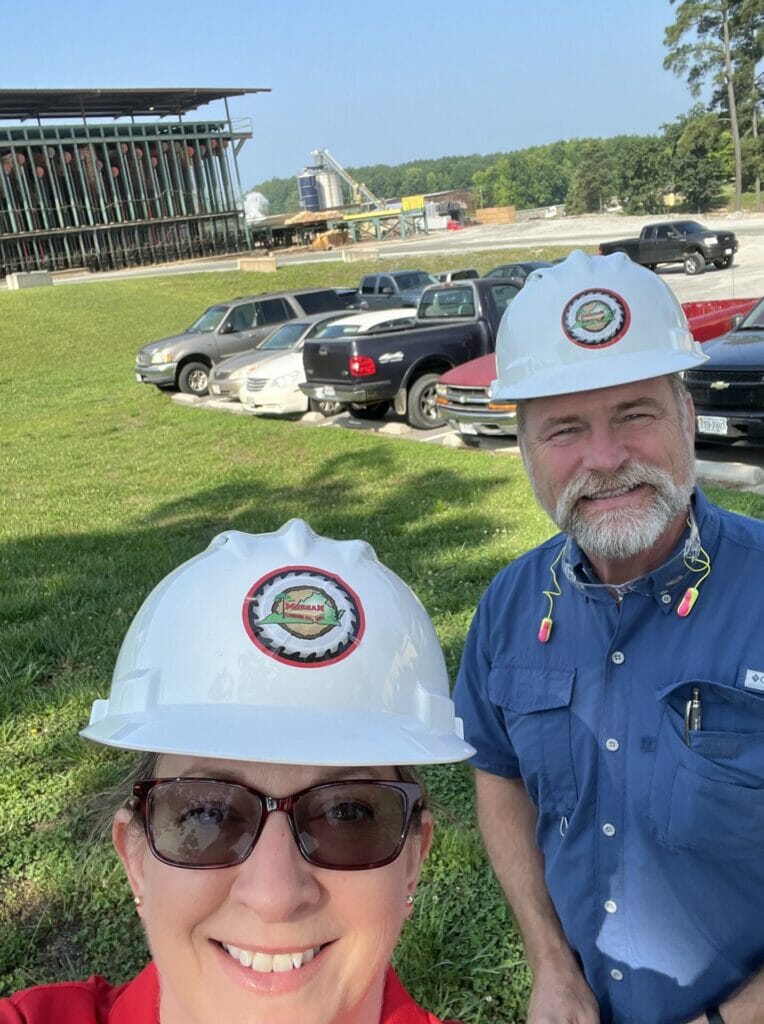
Wayne Talley, Carpentry Teacher at Mecklenburg County High School, and Deborah Talley, Family and Consumer Sciences Teacher, were two of the 21 participants in this year’s Exploring Careers through Industry Teacher Externships (EXCITE) program. Morgan Lumber Company was one of the industries they visited.
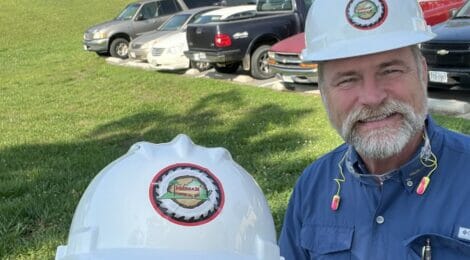
Morgan Lumber Company in Red Oak, Va., was one of the 25 organizations that hosted teacher externs this summer. Safety and Compliance Coordinator Lucas Bowman said the company is recruiting many employees and is trying to engage with the community. This opportunity, he said, represented an opportunity to do both of those things.
“We’re able to discuss our business and the challenges we face with finding new employees, skills that they might be lacking, and the teachers can see real-world situations where the things they might be teaching translate to careers in the area.” — Lucas Bowman, Safety and Compliance Coordinator, Morgan Lumber Company
Externships give employers like Morgan Lumber Company avenues of involvement with K12 school systems. Employers inform educators about their expectations of employees in various positions and offer input to their curriculum, thereby contributing to preparing their future workforce.
One simple required skill in most industrial settings is reading a ruler/tape measure. Many organizations shared this same example and said that many employees must learn this skill after starting.
“If we can relay little things like that to the educators, they can hopefully find ways to address it and incorporate that skill in future lessons,” Bowman said.
Employers can also become guest speakers and mentors, host field trips and job shadows, and offer internships for students. In-kind donations of time and expertise allow employers to show their commitment to their community.
Organizations or businesses in GO Virginia Region 3 that would like to participate in the EXCITE program in 2024 can learn more here and should reach out to Kiana Dillard.
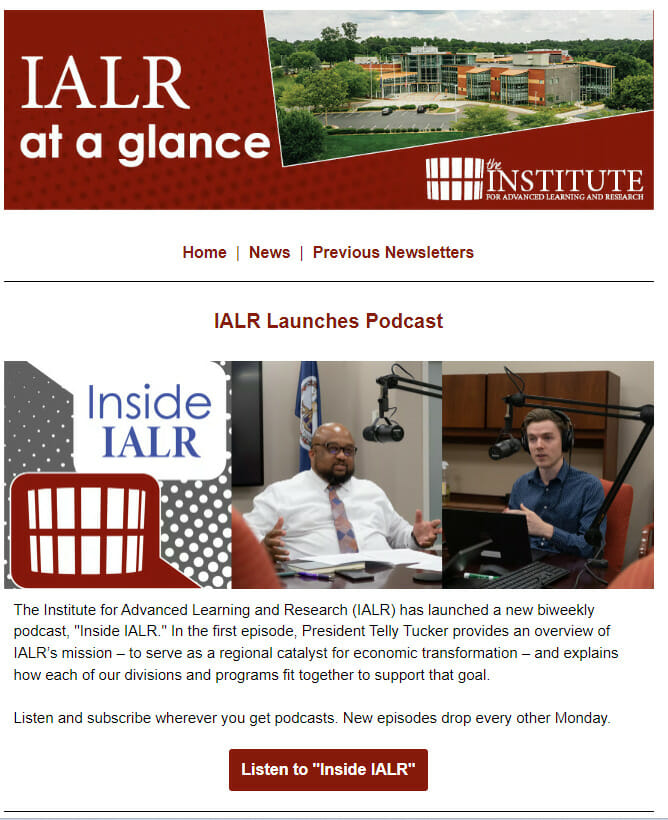
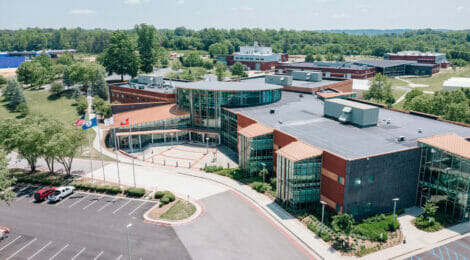
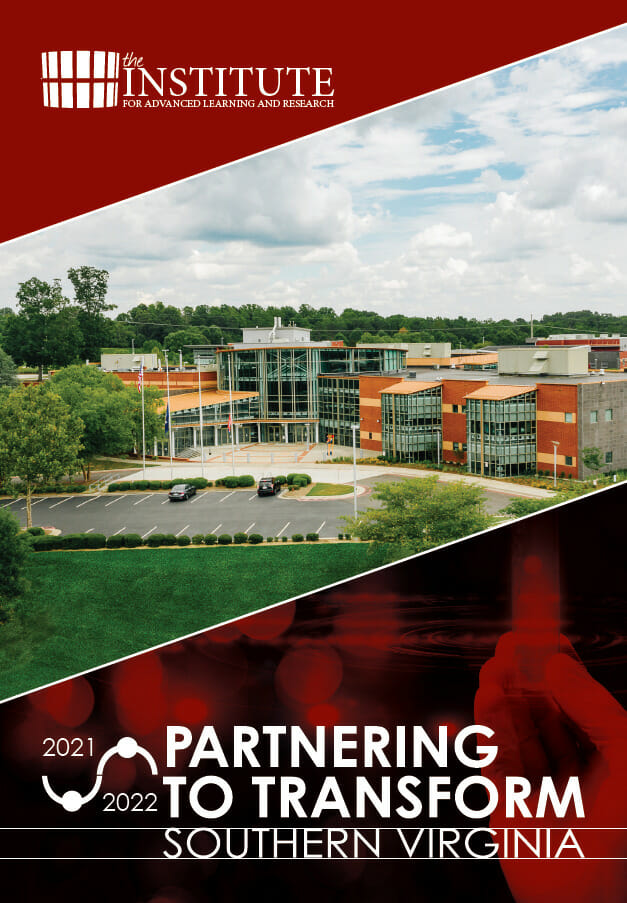 The Institute for Advanced Learning and Research (IALR) has published its 2021-2022 annual report, which highlights innovative and collaborative partnerships across departments that are transforming the economy of Southern Virginia.
“Significant economic growth has resulted due to robust partnerships across the region. IALR stands ready to serve as Virginia’s go-to partner for education and workforce development, business and economic growth, and a globally competitive business ecosystem.” – IALR President Telly Tucker.
One of the pivotal moments of the report period is the creation and adoption of the new IALR Strategic Plan, which will guide IALR’s work and efforts for the next five years. With input from key stakeholders, the plan establishes strategic goals to outline how IALR can best capitalize on its unique strengths to impact the region.
Just some of the new initiatives and programs launched, announced or expanded during FY 21 and FY 22:
The Great Opportunities in Technology and Engineering Careers (GO TEC™) framework is spreading into schools across the Commonwealth. The GO TEC program is just one component of the newly developed and proven EmPOWER system – an employer-driven model to systematically connect students to careers through career awareness, exposure, and engagement and experience. Future and current members of the workforce, as well as businesses, find joint benefits in problem-solving teamships, apprenticeships, externships and internships, mock interview days and more.
While striving to promote a diversified economy by serving a variety of industries, much of IALR’s impact in 2021-2022 was in the manufacturing sector. Expanding the existing middle-school-through-college workforce development pipelines, the new Accelerated Training in Defense Manufacturing (ATDM) program is a rapid adult-learner model that prepares talent for jobs in the defense industrial base. ATDM launched in 2020 and is already proving successful and showing what modern public-private partnerships should look like. In addition, IALR partnered with the Commonwealth of Virginia and Danville Regional Foundation to construct the Center for Manufacturing Advancement, a new destination for manufacturers ready to optimize and scale and home to the U.S. Navy’s Additive Manufacturing Center of Excellence.
Through the Controlled Environment Agriculture (CEA) Innovation Center, a joint project with Virginia Tech, IALR has established itself as a global leader in the CEA industry. The presence of the innovative research and state-of-the-art equipment are already making an impact on Southern Virginia. Thanks to best-in-class resources, including lab spaces and staff, the Applied Research team provided 30 companies with applied research and testing services like analytical chemistry, polymer testing and more.
In partnership with the Southern Virginia Regional Alliance (SVRA) and many other economic development organizations, IALR is proud to champion the area while working with local, regional and state partners. In FY 21 and 22, the Southern Virginia region saw $498 million in announced capital investment and 1,288 new jobs. IALR contributed to economic success by serving as a temporary home for growing businesses by providing critical testing services and lab space to innovative companies across industries. The Bridge to Recovery Program connected companies with suppliers and helped businesses become more resilient post-pandemic.
The Institute Conference Center hosted a variety of events geared toward the growth of industry sectors and Southern Virginia, including trainings and economic development activities. Numerous companies, including anchor and growing employers held successful job fairs, connecting community members with quality employment. An extensive renovation of the main building and a relaunch of Megabytes, IALR’s on-site café, have allowed the Institute Conference Center to provide even better service for the 20,800 guests who visited.

The Southern Virginia Regional Alliance (SVRA) is pleased to join localities of Halifax, Patrick and Pittsylvania Counties and the City of Danville in announcing twenty-one sites that will move from Tier-Two to Tier-Four sites (signifying shovel-ready sites) in the Virginia Business Ready Sites Program (VBRSP) and eight sites that will move from Tier-Two to Tier-Five (shovel ready sites with graded pad sites). SVRA received $1,534,900 from GO Virginia Region 3 and $454,100 from the Virginia Tobacco Region Revitalization Commission (TRRC) to further the preparation of sites in areas identified with specific assets for transportation such as rail and highway access, utilities inclusive of significant supply of natural gas, electricity and water supply along with a demonstrated available labor shed and workforce pipeline. Southern Virginia leads the Commonwealth in the number of prepared sites, one of the reasons for the success they are achieving in business attraction. The strategy by local elected officials, government and economic development staff to keep an inventory of ready sites that serve diverse industries, leads to sites that are ready to market for prospects who need to ensure that the risks of building on the sites have been assessed and minimized.
The SVRA service region has worked with the engineering firms of Dewberry and Reynolds and Clark to complete right-of-way; engineering and building for reliable, redundant and abundant sites across the region. The strategy for site development included meeting diverse needs and has resulted in six VBRSP Tier-4 industrial parks in the region that provide access to eight VBRSP Tier-5 graded sites that are ready for immediate construction. An additional 21 VBRSP Tier-4 sites have completed the engineering due-diligence and are ready for grading and building within 12-18 months.
Sites range in size from 3.4 to 67 acres with from 2.5-32 acres of developable pad sites that can readily accommodate buildings from 20,000 sq. ft. to 600,000 square feet in size. Some of the lots can be joined to accommodate larger pad sites for expansion capacity with up to double lot.
|
Industrial Park / Site Current Sites |
VBRSP Ranking |
Developable Pad on Site |
Potential Building Size |
|
|
|
|
|
|
Airside Lot 2J (Airside Industrial Park – Danville) |
Tier 5 |
17-acre pad on 50.44-acre site |
300,000 sq. ft. |
|
Recent Park Wins – Essel Propak Expansions, Lite House Expansions, Butonni (Nestle), & 2 pending announcements |
|||
|
|
|
|
|
|
Cane Creek Centre – Danville/Pittsylvania RIFA |
Tier 4 |
|
|
|
Recent Park Wins – Walraven, Morgan Olson, Aerofarms, Tyson |
|||
|
Cane Creek Lot 1B – Rail |
Tier 4 |
27-acre pad on 49.12-acre site |
370,000 sq. ft. |
|
Cane Creek Lot 6B |
Tier 4 |
21-acre pad on 24.78-acre site |
380,000 sq. ft. |
|
Cane Creek Lot 6C |
Tier 4 |
23-acre pad on 30.71-acre site |
310,000 sq. ft. |
|
Cane Creek Lot 8A |
Tier 5 |
8.5-acre pad on 22.7-acre site |
100,000 sq. ft. |
|
Cane Creek Lot 10 – Rail |
Tier 4 |
32-acre pad on 67-acre site |
450,000 sq. ft. |
|
Cane Creek Lot 11A – Rail |
Tier 4 |
14-acre pad on 20.6-acre site |
150,000 sq. ft. |
|
Cane Creek Lot 11B – Rail |
Tier 4 |
13-acre pad on 16.6-acre site |
150,000 sq. ft. |
|
Cane Creek Lot 12 A |
Tier 4 |
4.5-acre pad on 5.2-acre site |
54,000 sq. ft. |
|
Cane Creek Lot 12 B |
Tier 4 |
7-acre pad on 8.6-acre site |
72,000 sq. ft. |
|
|
|
|
|
|
Coleman Site – Rail – largest rail served site in state |
Tier 4 |
|
|
|
Coleman Site Lot 1 |
Tier 4 |
13-acre pad on 30-acre site |
125,000 sq. ft. |
|
Coleman Site Lot 2 – Rail |
Tier 4 |
44-acre pad on 50-acre site |
700,000 sq. ft. |
|
Coleman Site Lot 3 – Rail |
Tier 4 |
25-acre pad on 78-acre site |
500,000 sq. ft. |
|
|
|
|
|
|
Cyber Park |
Tier 4 |
|
|
|
Recent Park Wins – Institute for Advanced Learning and Research (3), EIT/Zollner, Kyocera, Overfinch, BGF, FasTech, MEP |
|||
|
Cyber Park Lot 5 |
Tier 4 |
13-acre pad on 39.42-acre site |
200,000 sq. ft. |
|
Cyber Park Lot 7D |
Tier 5 |
20.5-acre pad on 62.86-acre site |
250,000 sq. ft. |
|
Cyber Park Lot 10C |
Tier 4 |
10-acre pad on 27.96-acre site |
100,000 sq. ft. |
|
Cyber Park Lot 12 B |
Tier 4 |
8-acre pad on 19.3-acre site |
100,000 sq. ft. |
|
|
|
|
|
|
Day Site – Halifax County |
Tier 4 |
|
|
|
Day Site Lot |
Tier 4 |
30-acre pad on 34 -acre site |
50,000 sq. ft. |
|
|
|
|
|
|
Rich Creek Corporate Park – Patrick County |
Tier 5 |
|
|
|
Recent Park Wins – Ten Oaks Expansion |
|||
|
Rich Creek Pad Site |
Tier 5 |
25-acre pad on70 -acre site |
100,000 sq. ft. |
|
Rich Creek site with Shell Building |
Tier 5 |
10-acre pad on 14-acre site |
20,000 sq. ft. |
|
|
|
|
|
|
Ringgold East Industrial Park |
|
|
|
|
Recent Park Wins – Axxor Expansion, Panaceutics |
|||
|
Ringgold East Site – Pittsylvania County – Rail |
Tier 5 |
28.3-acre pad on 51.04-acre site |
600,000 sq. ft. |
|
|
|
|
|
|
Riverview Industrial Park |
|
|
|
|
Recent Park Wins – JTI Expansion |
|||
|
Riverview Lot 5B – Riverview Industrial Park Danville |
Tier 4 |
6-acre pad on 11-acre site |
72,000 sq. ft. |
|
|
|
|
|
|
Southern Virginia Technology Park |
Tier 4 |
|
|
|
Recent Park Wins – IperionX |
|||
|
SVTP Lot A |
Tier 4 |
3-acre pad on 3.4-acre site |
31,250 sq. ft. |
|
SVTP Lot B |
Tier 5 |
11-acre pad on 14.7-acre site |
122,500 sq. ft. |
|
SVTP Lot C |
Tier 4 |
9-acre pad on 17-acre site |
97,500 sq. ft. |
|
SVTP Lot D |
Tier 4 |
6.5-acre pad on 29.4-acre site |
31,250 sq. ft. |
|
SVTP Lot E |
Tier 5 |
4.5-acre pad on 6.7-acre site |
48,000 sq. ft. |
|
SVTP Lot F |
Tier 5 |
9.5-acre pad on 12.6-acre site |
106,500 sq. ft. |
|
SVTP Lot G |
Tier 4 |
2.5-acre pad on 7.6-acre site |
20,000 sq. ft. |
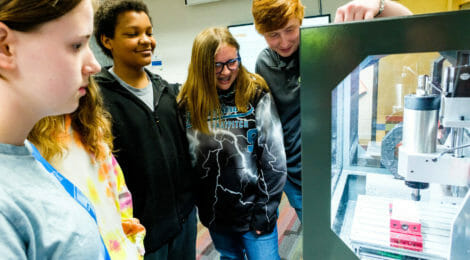
In partnership with community employers, economic developers, K-12 divisions and higher education institutions, the Institute for Advanced Learning and Research (IALR) and GO Virginia Region 3 will utilize $3.4 million in recently announced GO Virginia funds to scale the Great Opportunities in Technology and Engineering Careers (GO TEC™) framework into additional localities across the Commonwealth. These funds will allow for the addition of In-Region Coordinating Entities (IRCEs) and IALR GO TEC staff in three GO Virginia regions (1,4, and 5), building the infrastructure and administrative capacity to expand the existing, proven GO TEC model.
“The GO TEC framework has been incredibly successful, both as a pilot program right here in Danville and Pittsylvania County and as we have partnered with other localities across Virginia,” said Dr. Julie Brown, Vice President of Advanced Learning at IALR. “With this additional funding from GO Virginia, we will be able to support the current and anticipated expansion into dozens of K12 schools across multiple regions of the Commonwealth. I’m excited to see how GO TEC makes a positive, direct impact on the students, educational systems, economic development efforts, and overall success of these regions, just like it has in Southern Virginia.”
“GO TEC Virginia 2025 demonstrates that like-minded leaders from education, business, non-profit organizations, and government can work together to create for our students a clear pathway to high-paying jobs in their hometowns,” said Tim Clark, Chair of GO Virginia Region 3 Council. “GO Virginia Region 3 is pleased to have supported the growth of a partnership between IALR staff and Southern Virginia’s school divisions and community colleges to make GO TEC a success for our students and businesses – a partnership that will now be expanded to benefit other regions in Virginia.”
The GO TEC program is expanding into the following GO Virginia regions and localities:
GO TEC delivers workforce training and talent development through a collaborative, hub-and-spoke model that involves K-12 school systems, higher education and industry. Starting in middle school Career Connections Labs and continuing through high school, dual enrollment, and post-secondary programs, GO TEC engages students in hands-on learning in high-demand career pathways such as precision machining, welding, IT and cybersecurity, robotics and automation, mechatronics, and advanced materials.
GO Virginia, Virginia’s initiative for growth and opportunity in each region, is an economic development initiative through the Virginia Department of Housing and Community Development that supports programs to create more high-paying jobs through incentivized collaboration between business, education and government. This expansion of GO TEC is the result of $3,474,821 in GO Virginia grant funding, which was part of more than $5 million in GO Virginia grants announced by Governor Youngkin in December 2022. The state funds are matched with $2,4426,079 in local and federal funds from the partner organizations. The GO TEC program already has a strong presence in GO Virginia Region 3, including in Danville, Pittsylvania County, Martinsville City school divisions and several others.
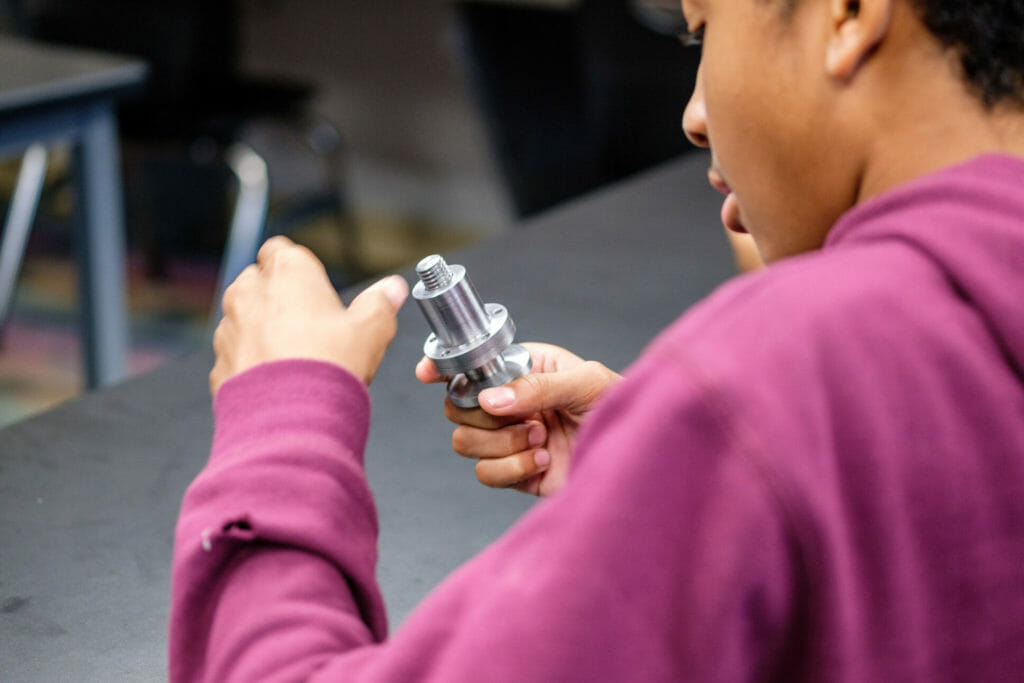
As of spring 2023, GO TEC Labs are available in 25 middle schools across 19 school divisions. These recently awarded funds will allow the GO TEC program to expand into additional localities in the southwest, central, and Greater Hampton Roads areas of the Commonwealth. As a result of these funds, IALR anticipates that the GO TEC program will be available in 50 middle schools by 2025.
IALR and GO Virginia Region 3 will remain the primary administrators, but these funds will allow for the creation of three additional training labs across the Commonwealth, bringing the total to four. These funds will also establish GO Virginia In-Region Coordinating Entities (IRCEs) that will partner with IALR to drive GO TEC expansion – supporting teachers, validating talent pathway opportunities, and quantifying Virginia’s return on investment in the form of job creation, job placement and private sector investment. The United Way of Southwest Virginia will serve as the IRCE in Region 1. The Commonwealth Center for Advanced Manufacturing (CCAM) will serve as the IRCE in Region 4. Old Dominion University Research Foundation (ODURF) will serve as the IRCE in Region 5.
“The Commonwealth Center for Advanced Manufacturing (CCAM), with support from Virginia State University and Brightpoint Community College, are proud to be the In-Region Coordinating Entity for GO TEC Virginia 2025,” said CCAM President & CEO John Milton-Benoit. “This initiative strengthens our ties with our K-12 partners and will generate excitement for students to enter into STEM-related careers. We applaud the Institute for Advanced Learning and Research for their vision of a long-term workforce pipeline solution for advanced manufacturing companies in the Commonwealth of Virginia.”
“ODU is excited to support the expansion of the successful GO TEC program into Hampton Roads to grow tech and engineering careers,” said Morris Foster, Vice President for Research at ODU. “This grant will help ODU and our partners continue to bolster the talent pipeline for the skilled trades that power our region.”
“United Way of Southwest Virginia is excited for what this funding means for our region’s workforce,” said Travis Staton, President and CEO of the United Way of Southwest Virginia. “Technology and engineering tend to produce high-paying jobs, something our area needs. GO TEC is known for creating pipelines of skilled workers to empower these industries and the United Way of Southwest Virginia is known for researching, building, and scaling programs. This is a powerful collaboration that can help our region gain a competitive edge.”
The existing program coordinator, program manager, and technical and training manager will continue operating out of IALR. Each region will have an additional training coordinator and program coordinator that will support GO TEC activities in their respective regions. These funds will not only be used to scale the program, but will develop an effective data evaluation plan and model to monitor and evaluate results.
GO TEC began as a successful pilot program with middle school Career Connections Labs and curriculum development starting in 2018 in Danville and Pittsylvania County. With a $4.9 million GO Virginia grant in 2019, the program was expanded throughout GO Virginia Region 3 and into regions 1 and 4.
The Institute for Advanced Learning and Research serves Virginia as a regional catalyst for economic transformation with applied research, advanced learning, advanced manufacturing, conference center services and economic development efforts. IALR’s major footprint focuses within Southern Virginia, including the counties of Patrick, Henry, Franklin, Pittsylvania, Halifax and Mecklenburg along with the cities of Martinsville and Danville. For more information, visit www.ialr.org.
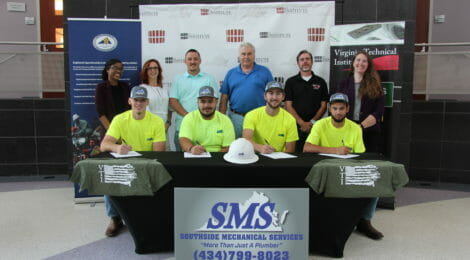
IALR to create regional apprenticeship consortium and serve as VA DOLI intermediary sponsor for employers
The Tobacco Region Revitalization Commission (TRRC) has awarded the Institute for Advanced Learning and Research (IALR) a grant of $497,890 for its ExTRA (Expanding Talent through Registered Apprenticeships) program to grow state registered apprenticeships within the 15 Southern Virginia localities throughout GO Virginia Region 3. IALR will create a regional apprenticeship consortium to recruit apprentices and employers, as well as serve as the Virginia Department of Labor and Industry’s (DOLI) intermediary sponsor to help employers lacking capacity to fulfill the role as primary sponsor.
Virginia’s Registered Apprenticeship program is an occupation-specific training model designed to produce highly skilled workers to meet the demands of employers. The model includes a combination of on-the-job training and related technical instruction with a paid job experience for the employees.
“Apprenticeships are a win-win for both employers and job seekers willing to learn on the job,” said Dr. Julie Brown, Vice President, Advanced Learning, IALR. “The employer remains globally competitive by recruiting and retaining a highly skilled staff, and the job seeker receives a job with a good starting wage, valuable training and the chance to earn a portable Journeyworker credential without accumulating debt.”
In alignment with economic development interests and employer needs, IALR will focus on expanding apprenticeships for occupations in construction, healthcare, early childhood education, manufacturing and information technology. TRRC funding will support the following:
IALR plans to provide assistance for up to 36 new apprentices each year for three years, for a total of 108 apprentices (recognizing that depending on the selected occupation apprenticeship, terms can run one, two, three or four years). Employers will provide wages and fringe benefits averaging $16 per hour.
New apprenticeships will be registered through the state DOLI. Apprentices who succeed in this program will receive their Journeyworker credential, a nationally recognized certificate demonstrating an individual has completed an apprenticeship and has the ability to perform all tasks of the trade in the area certified.
The Danville Regional Foundation and employers will provide matching funds for the grant. The total estimated contribution from employers (for apprenticeship wages and benefits) is over $7 million for the three years of the grant period.
The TRRC grant award is a follow-up to the $64,800 2021 TRRC grant award, which funded the development of an implementation plan with a list of employers, by sector, who were interested in establishing an apprenticeship program; and details on the credentials for the different apprenticeship programs and associated training needs. Apprenticeship Coordinator Natori Neal of IALR, hired as part of this project, completed the aforementioned requirements, worked to have IALR approved as a Virginia DOLI intermediary sponsor, and has already begun assisting employers through the apprenticeship process.
“IALR works to increase awareness for registered apprenticeship as a high-quality, work-based learning model, provide companies with program development and registration support, and offer connections to resources that are integral to program sustainability,” said Neal. “We also have the capability to manage the administration of programs for businesses that do not have the capacity to serve as the primary sponsors of apprenticeship programs.”
Neal has helped five employers establish registered apprenticeship programs and currently has one company participating as an employer of record in an IALR-sponsored apprenticeship program.
“The journey to establish our apprenticeship program has not been one we’ve traveled alone,” said Justin Hylton, Vice President of plumbing solutions provider Southside Mechanical Services Inc. in Danville. “We’ve had a lot of help from the folks at the Institute for Advanced Learning and Research, our DOLI representative, as well as the people with Virginia Technical Institute.”
State registered apprenticeships are one aspect of IALR’s EmPOWER framework to promote work-based learning. An employer-driven system, EmPOWER provides job seekers opportunities and tools for career awareness, career exposure and engagement, and career experience, all to drive employment.
“ExTRA aligns perfectly with the Commonwealth’s goals to increase opportunities for licensing, training and job opportunities for in-demand, high-paying skilled positions,” said Jessie Vernon, Program Manager, IALR. “IALR is here to serve as an accessible resource and helpful guide for businesses and potential apprentices. In this way, we hope to generate more state registered apprenticeships, what we consider to be the pinnacle of work-based learning experiences.”
Interested businesses or potential apprentices should contact Neal at natori.neal@ialr.org or 434.766.6657.
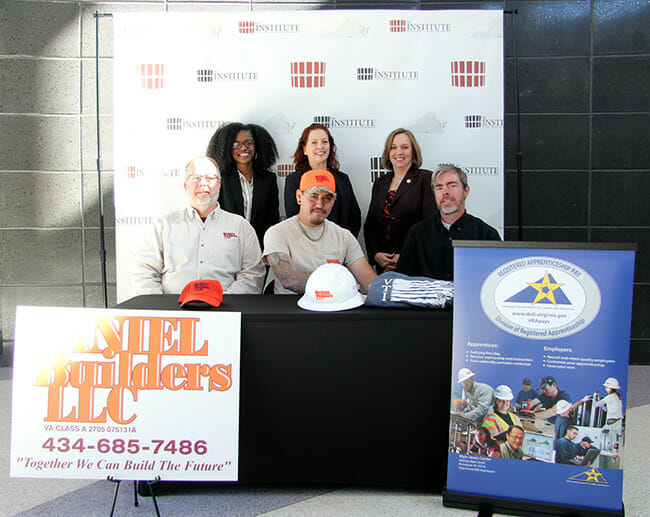
(L-R) First row: John Daniel (Daniel Builders, LLC), Ulises Jimenez, David Sage (Virginia Technical Institute); second row: Natori Neal (IALR), Kara Joyce (Virginia Department of Labor and Industry), and Dr. Julie Brown (IALR) participate in a signing ceremony.
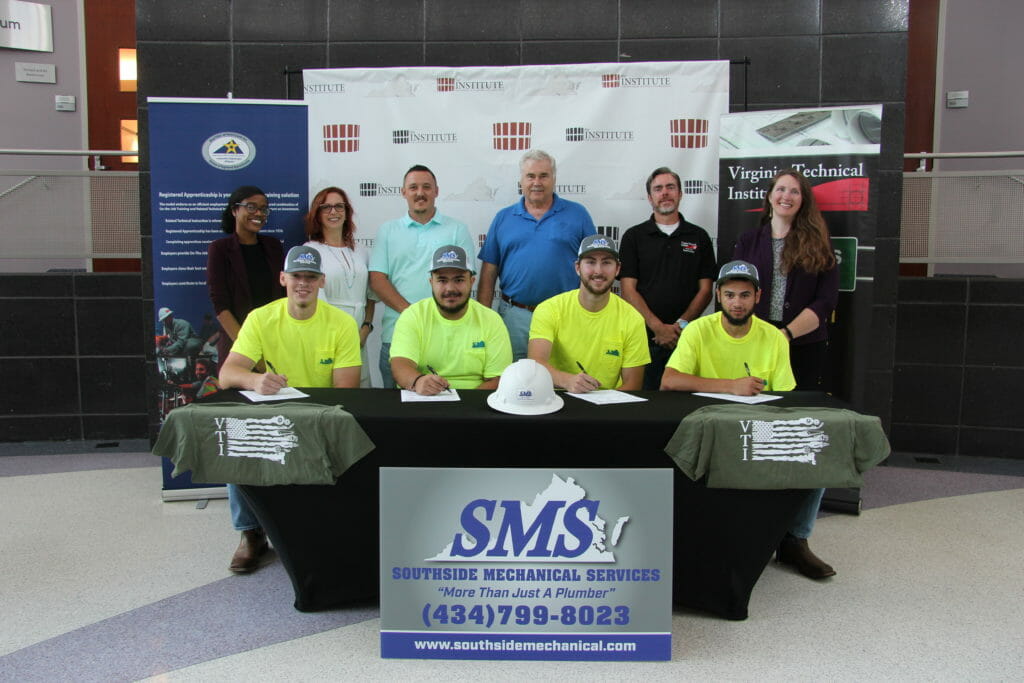
(Left to right) Front: Plumber apprentices Corey Woods, James Hess, Caleb Shelton and Anthony Worsham Jr.; back: Natori Neal, IALR; Kara Joyce, Virginia Department of Labor and Industry (DOLI); Justin Hylton, Vice President, Southside Mechanical Services (SMS); George Hylton, Owner/ President, SMS; David Sage, Executive Director, Virginia Technical Institute (VTI); and Jessie Vernon, IALR. IALR worked with DOLI and VTI to help SMS achieve registration as a state apprenticeship sponsor.
The Southern Virginia Workforce Solutions Summit is a joint effort of the Southern Virginia (SoVa) Taskforce which is comprised of economic developers and chamber executives across the southern Virginia region and workforce providers across the region. With the support of GoVa Region 3, the taskforce worked collaboratively through the COVID Pandemic to address industry needs. The number one request as the region emerges from the pandemic remains employee recruitment and retention.
On Wednesday, September 7th from 8 AM – 5 PM at the Institute for Advanced Learning and Research, the SoVa Taskforce will provide a Workforce Solutions Summit targeting the concerns, solutions and opportunities to emerge from this workforce shortage in a more competitive position, working with a better qualified and dedicated employee team. The summit will address key areas like:
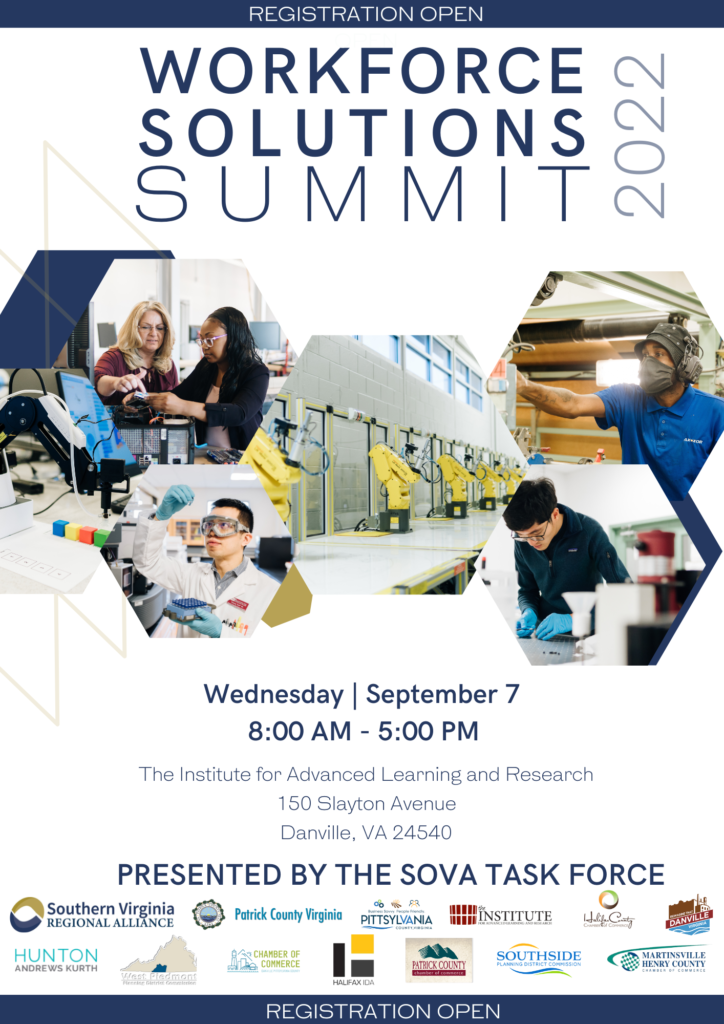

The SOVA Task Force offered a Workforce Solutions weekly webinar series in May as an extension of the Bridge to Recovery Grant provided by GO Virginia Region 3. The series provided employers with resources and best practices regarding today’s workforce.
“Amid all the pressures facing our businesses in the wake of COVID, solutions for workforce-related issues are repeatedly sought,” said Linda Green, Executive Director of the Southern Virginia Regional Alliance (SVRA). “Therefore, we convened experts and resources to assist with these Human Resources needs.”
The Workforce Solutions webinar series addressed Childcare, Afterschool Care and Elder Care; Recruiting and Onboarding Employees; Trainings, Apprenticeships, Internships and Re-entry Programs; Higher Education, Skill Sets, Certifications and Recertifications; and Retention, Promotion and Advancement.
During one webinar, Steve Youll of the Virginia Economic Development Partnership Talent Attraction Program shared how talent attraction has evolved with increased expectations by candidates. He said “72% of job seekers report sharing negative candidate experiences online” and “55% of candidates will avoid certain companies after reading negative online reviews.”
Moderators included workforce experts Dr. Julie Brown of IALR and Robbie Knight of Virginia Career Works-West Piedmont. The series was originated, organized and marketed by the SOVA COVID-19 Task Force, which is managed by the Southern Virginia Regional Alliance.
Recordings are available at svra.org under COVID-19 Economic Resources. In the future, similar programs will be provided in the eastern part of the GO Virginia Region 3 service area.
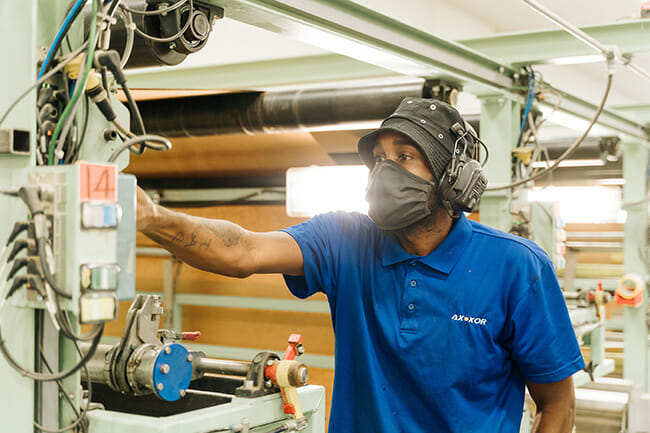
The SOVA Task Force webinars are part of the GO Virginia Region 3 Bridge to Recovery Grant. Regional employers like Axxor have adapted to the impact of COVID while continuing safe operations.
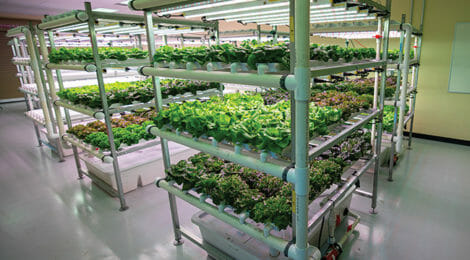
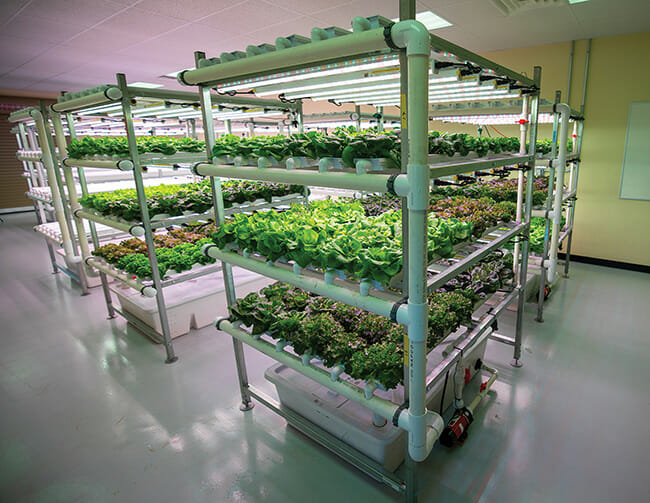
Hydroponic lettuce is one of the plants undergoing research at the CEA Center, which combines engineering, plant science and computer-managed greenhouse control technologies.
IALR and the Virginia Tech Center for Economic and Community Engagement received a grant to help grow the Controlled Environment Agriculture (CEA) sector in GO Virginia Region 3. The $77,053 grant will fund development of a strategy and roadmap for supporting industry growth and workforce development for CEA throughout the region. The effort will include an analysis of this emerging and dynamic agribusiness sector, including its industry and economic growth potential, while identifying needed facilities and infrastructure, workforce development issues, opportunities and applied research assets.
“A key outcome of the study will be to identify future needs and opportunities to support controlled agricultural production facilities and the underlying business investment for use by local and regional economic development and workforce development organizations and professionals,” said IALR Director of Applied Research Dr. Scott Lowman.
Controlled Environment Agriculture is an opportunity to attract and expand agribusiness investments. For instance, AeroFarms recently broke ground on a $53 million investment to build one of the largest aeroponic vertical farms in Danville. Nearby on IALR’s campus resides the focal point of the grant initiative, the Controlled Environment Agriculture Innovation Center, which is a partnership with Virginia Tech’s School of Plant and Environmental Sciences.

IALR, SOVA RISE, SOVA Innovation Hub and Longwood University support grant-funded teaching of District C Teamship Model

John Hatchett (right), coordinator and engineering instructor for the Academy for Engineering and Technology (AET), brainstorms with educators as part of the District C Coaching Institute, which teaches how to implement the Teamship model. Hatchett introduced the model—which pairs teams of students with local businesses to solve a real problem—to his AET juniors in 2020 as part of the Institute for Advanced Learning and Research’s Next generation Of Work (NOW) program.
The Institute for Advanced Learning and Research (IALR), District C and the SOVA RISE Collaborative (led by the SOVA Innovation Hub and Longwood University) are teaming up to recruit Southern Virginia educators for a cutting-edge coaching program. Sixteen educators from across GO Virginia Region 3 will be selected to join the 2022 Winter/Spring District C Coaching Institute where they will discover how to prepare students for the modern world of work with a unique, work-based learning model.
The District C Coaching Institute (supported by IALR and SOVA RISE) is a professional development experience that empowers educators to bring Teamship, a team-based internship model, back to their classroom. In Teamship, students use skills in critical thinking, collaboration, communication, creative thinking and citizenship (known as the five C’s expected by the Virginia Department of Education) to solve a real problem for a local business. Teamship may be executed as part of a class, bringing valuable work-based learning to students and building their social capital by connecting them with real companies rather than case studies.
IALR has been implementing the Teamship model through their Next generation Of Work (NOW) program since Spring 2020. “Our first cohort was done completely virtually with our Academy for Engineering and Technology juniors. Despite knowing that they wouldn’t be graded on their participation (due to the pandemic), EVERY student stayed engaged with their team and business partner’s problem and presented their final pitch,” said Jessie Vernon, Advanced Learning at IALR.
Through just four cohorts, 62 students have worked with nine business partners. “With just a five-hour commitment from participating businesses, the potential for each business to work with up to 12 students… not to mention the ROI for businesses as students work to solve major pain points… we feel very strongly this is an amazing work-based learning model for our region,” said Vernon.
The 2022 Winter/Spring District C Coaching Institute will equip regional educators with the skills and tools they need to implement the Teamship model at their school. Each educator selected will receive a grant to cover the cost of their professional development, and each educator’s school will receive a grant to cover the cost for the first year of their membership to District C. The application deadline for the coaching institute is Dec. 14. Educators and businesses interested in more information may contact jessie.vernon@ialr.org.
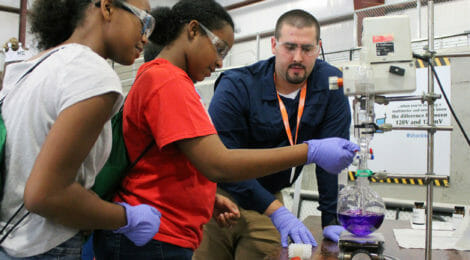
The Institute for Advanced Learning and Research (IALR) was recently awarded over $581,000 to lead ExperienceWorks, a work-based learning (WBL) system that leverages GO Virginia Region 3 and Tobacco Region Revitalization Commission (TRRC) investments. The system connects students and young adults to high-skill, high-wage employment opportunities through a variety of career development and WBL opportunities.
“We are grateful for these investments supporting robust public and private partnerships that are required to launch the ExperienceWorks framework,” said Dr. Julie Brown, Director of Advanced Learning at the Institute for Advanced Learning and Research (IALR). “ExperienceWorks aligns existing career development programs and adds capacity, providing multiple opportunities for employers to engage with students and offer hands-on, career-relevant learning and mentoring.” Brown adds, “The participating school divisions are excited about this opportunity to continue collaborating on programs which benefit their students, faculty, and the region’s business community. We’re thankful that the GO Virginia Region 3 Council, the GO Virginia State Board, the Department of Housing and Community Development, and the Tobacco Region Revitalization Commission recognized and endorsed their efforts.”
Randy Lail, Chair, GO Virginia Region 3, stated, “ExperienceWorks provides targeted industries with skilled employees for high-wage, high-skill jobs to position their companies for growth and will significantly advance the Region 3 Council’s priorities.” GO Virginia Region 3 per capita funds will support 50 percent of the cost for an Internship Coordinator as well as paid internships, work-readiness bootcamps, and teacher externships.
The TRRC grant funds will support 50 percent of an Apprenticeship Coordinator position adding capacity for employer outreach and developing apprenticeship positions in partnership with regional employers. Tobacco Commission member, Dr. Alexis Ehrhardt said, “Apprenticeship and job readiness programs have long been an area of focus for the Tobacco Commission and I am glad the Commission chose to support this program at IALR. The ExperienceWorks program will be a real asset to our region by providing opportunities for students to engage directly with leading businesses in their chosen field. I am confident this will result in increased employment opportunities for our students and allow our local businesses to hire for many hard to fill positions.”
The mission is to scale WBL efforts, allowing 100 percent of high school graduates to access a high-quality WBL experience and create a sustained pathway that connects employers to their emerging workforce. This initiative is targeted to high school juniors and seniors and is designed to create a culture of understanding that internships and apprenticeships are for everyone, with a clear benefit for employers and job seekers.
ExperienceWorks goals include: increased student awareness of career opportunities in strategic industry sectors; improved student and young adult work readiness skills aligned with business expectations; meaningful work experiences for students and young adults in strategic sectors; increased teacher and counselor awareness of careers and business needs; and a work-based learning system that is sustained and supported by employers, local government and economic development. According to Brown, “Establishing connections with students while they are still in high school will allow businesses to access an emerging workforce and provide mentorship, increasing the number of high school graduates who are connected to employment opportunities in targeted growth sectors.”
Participating K12 divisions include: Amelia, Brunswick, Charlotte, Cumberland, Danville, Halifax, Henry, Lunenburg, Martinsville, Mecklenburg, Nottoway, Patrick, Pittsylvania, and Prince Edward. For more information about ExperienceWorks, contact Jessie Vernon at jessie.vernon@ialr.org or 434-766-6772.
This project was funded in part by GO Virginia, a state-funded initiative administered by the Virginia Department of Housing and Community Development (DHCD) that strengthens and diversifies Virginia’s economy and fosters the creation of higher wage jobs in strategic industries. GO Virginia is a statewide business-led economic development initiative with funding to invest in collaborative projects that lead to high-paying jobs in each region. The mission of GO Virginia is to encourage collaboration among business, education, and government in each region. GO Virginia Region 3 is one of nine regions in Virginia and includes the Counties of Amelia, Brunswick, Buckingham, Charlotte, Cumberland, Halifax, Henry, Lunenburg, Mecklenburg, Nottoway, Patrick, Pittsylvania and Prince Edward and the Cities of Danville and Martinsville. For more information, please visit govirginia3.org and sign up for the Region 3 monthly newsletter or connect with GO Virginia Region 3 on Facebook or LinkedIn
The Tobacco Region Revitalization Commission is a 28-member body created by the 1999 General Assembly. Its mission is the promotion of economic growth and development in formerly tobacco-dependent communities, using proceeds of the national tobacco settlement.

Students at the 2019 Career ChoICE Youth Expo visit the booth of Sartomer (Chatham), a division of Arkema Inc., for a hands-on introduction to careers in advanced materials and chemical manufacturing. The Expo exposes youth to the 17 career clusters, and it serves as one component of the newly funded ExperienceWorks work-based learning system framework to be led by the Institute for Advanced Learning and Research.
